Where can ecological photography go next?
Ive been thinking about where ecological photography might go next.
We know the familiar visual language of climate change: melting ice, burning forests, drought, pollution and damaged landscapes. But what happens when artists stop simply photographing ecological catastrophe and start questioning the relationship between the environment, the image and the person looking at it?
Three artists have been making me think about this in very different ways.
Noémie Goudal — constructing the landscape
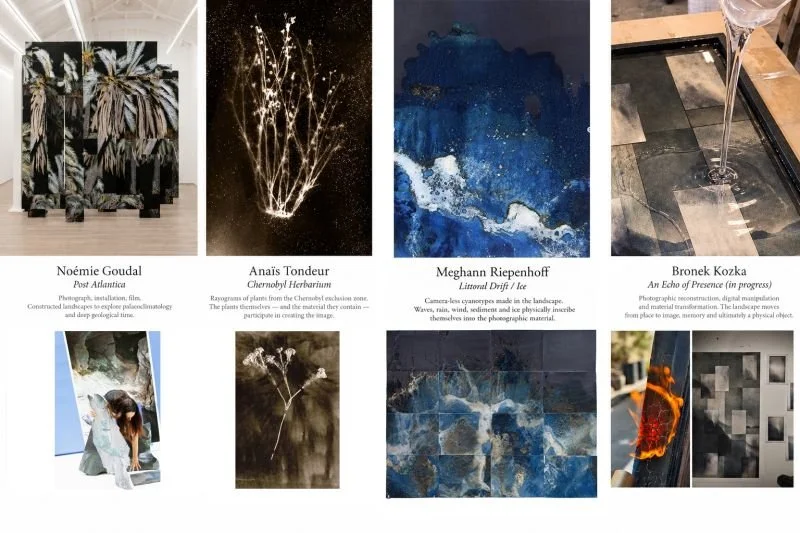
In Post Atlantica, Goudal uses photography, film and installation to engage with palaeoclimatology and deep geological time. She constructs artificial landscapes within real environments, deliberately leaving the seams and scaffolding visible.
The landscape is both real and fabricated. The constructed image becomes a way of thinking about geological time — a scale almost impossible for us to experience.
Anaïs Tondeur — allowing the environment to make the image
In The Chernobyl Herbarium, developed with philosopher Michael Marder and biogeneticist Martin Hajduch, Tondeur creates rayograms from plants originating in the Chernobyl exclusion zone. The plants become direct photographic traces, carrying the history of the contaminated site.
In Fiori di Fuoco (Flowers of Fire), she works with ruderal plants growing in the contaminated Terra dei Fuochi in Italy, using phytography to allow the plants’ own chemistry to participate in creating the photographic trace.
The landscape is no longer simply the subject. It becomes a participant in making the image.
Meghann Riepenhoff — surrendering the image to the landscape
In Littoral Drift and Ice, Riepenhoff makes camera-less cyanotypes directly in landscapes. Waves, rain, wind, sediment and ice physically inscribe themselves into the photographic materials.
The environment isnt photographed. It helps make the photograph.
These artists have made me think about my own relationship with landscape and the photographic image.
In my own practice, the landscape increasingly moves through:
place → image → memory → reconstruction → object
This is part of the thinking behind An Echo of Presence: moving away from simply asking, “What does the landscape look like?” and towards, “What does being in a landscape reveal about us?”
What interests me is that none of these artists are simply trying to make a better picture of climate change.
They are questioning what photography can do.
Can it construct a landscape?
Can the environment participate in making the image? Can the physical forces of a place become part of the photographic process?
Perhaps the future of ecological photography isnt about finding new ways to photograph environmental catastrophe, but new ways to understand our place within the environment — and what photography can reveal about that relationship.
www.kozka.com