
Public sculpture, in development
Koi to Dragon / 鲤鱼跃龙门
2025–2026
In Chinese legend, koi that swim against the current of the Yellow River and leap the Dragon Gate are turned into dragons. The story has lasted for centuries because it is about effort. The change comes from the swim, not from luck.
The sculpture was conceived for a wine estate in Victoria's Yarra Valley. Winemaking runs on the same idea. Vines take years to give good fruit, and each vintage asks for patience through frost, drought and uncertain seasons. Grapes become wine only through time and care.
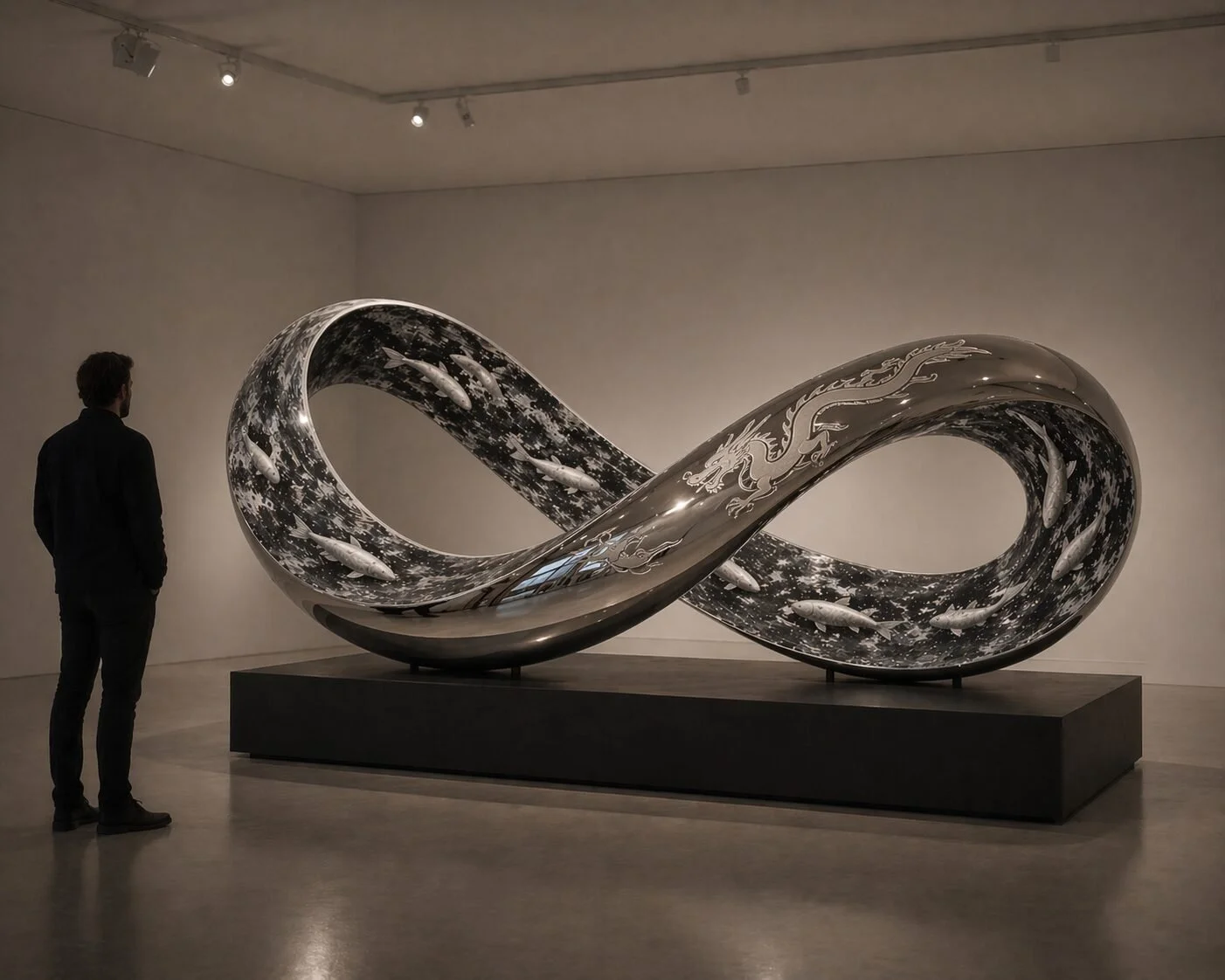
The form is a Möbius band: a surface with one side and one edge. Follow it with your eye and you pass from inside to outside without crossing a line. Koi and dragon sit on the same continuous surface, so the journey and the change become one thing.
From the sketchbook
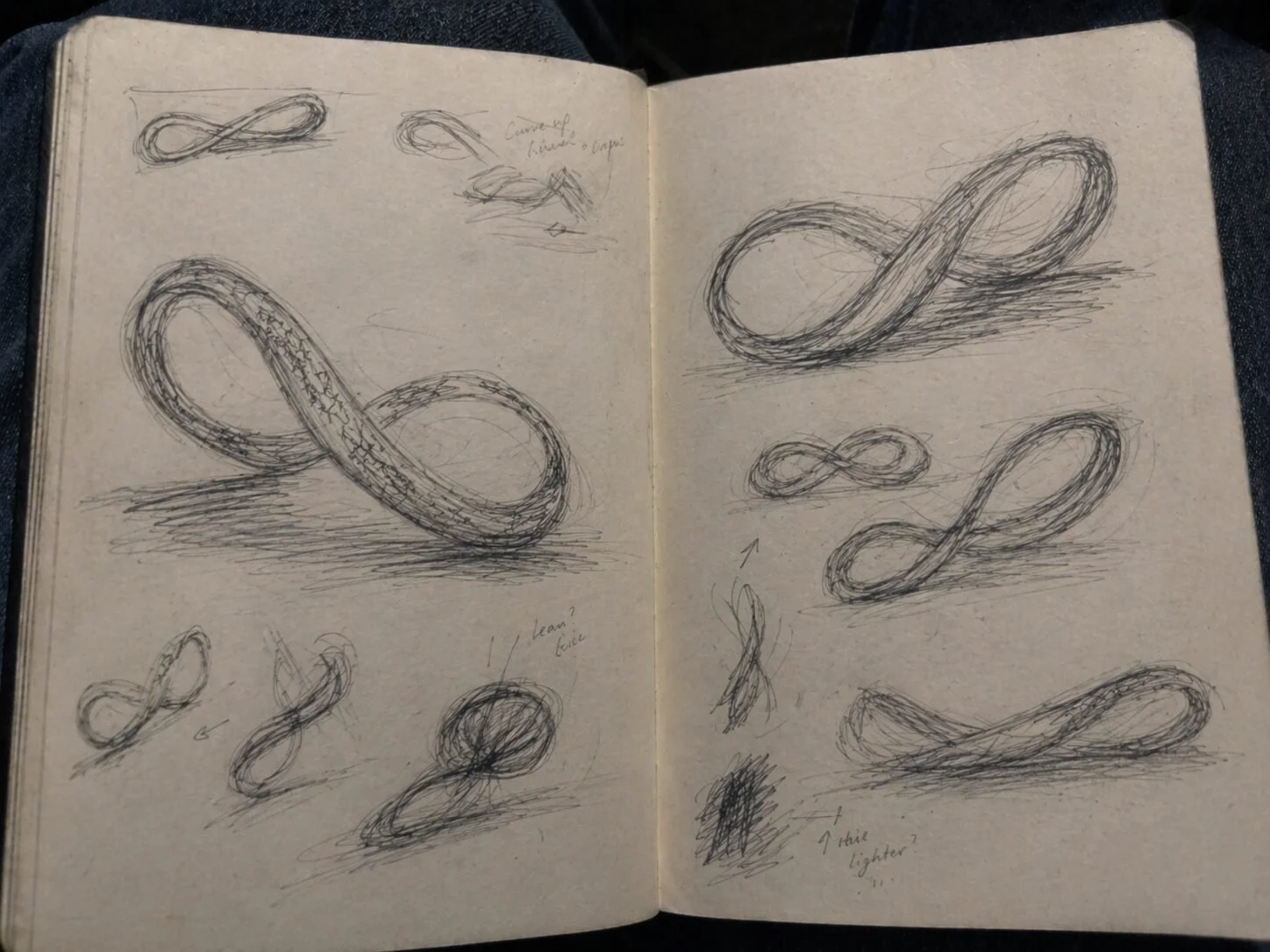
The work began on paper. Page after page of figure-eights and twisted loops, testing balance, weight and where the band meets the ground. A small standing figure beside the larger drawings checks the scale against a person.
The notes on the first page set the brief early, and it has held.
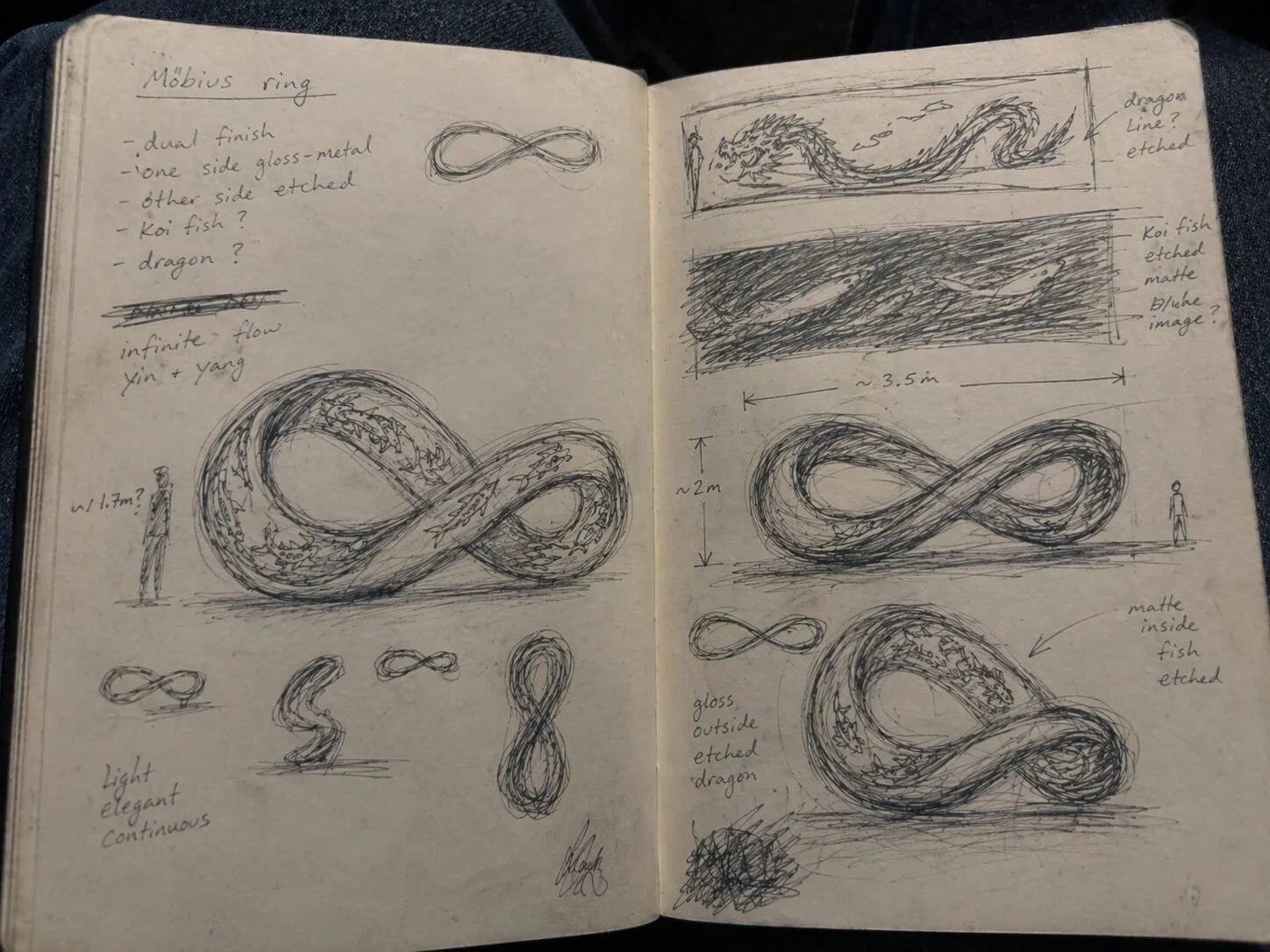
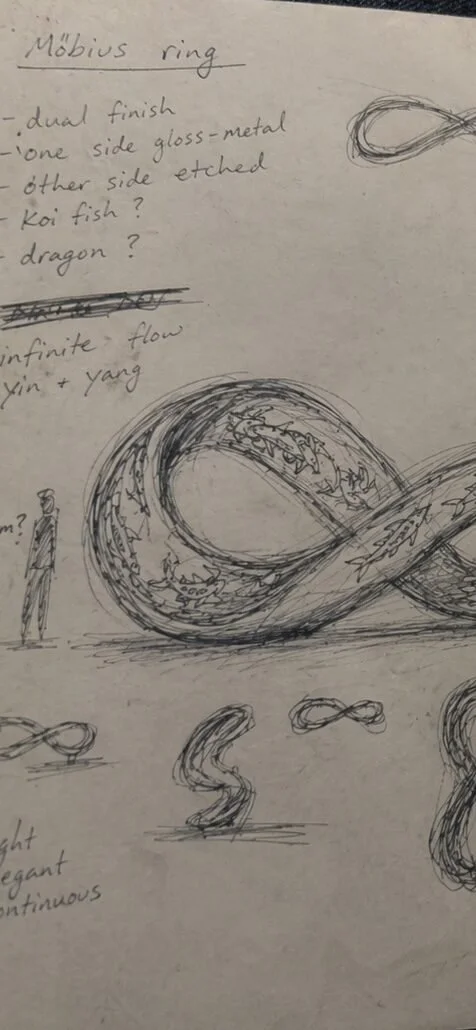
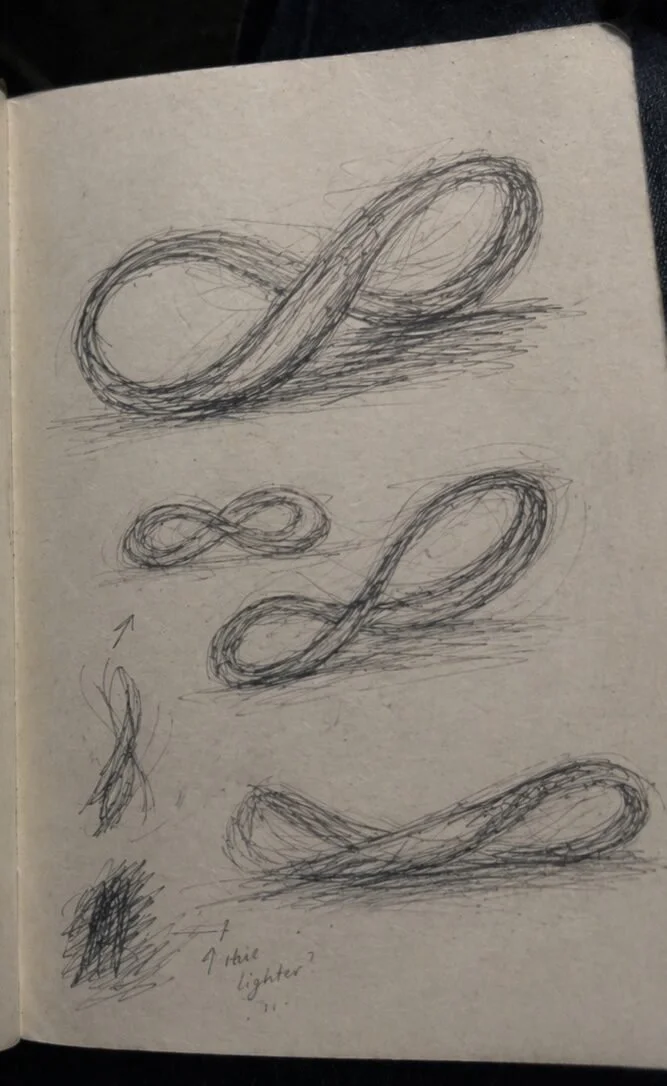
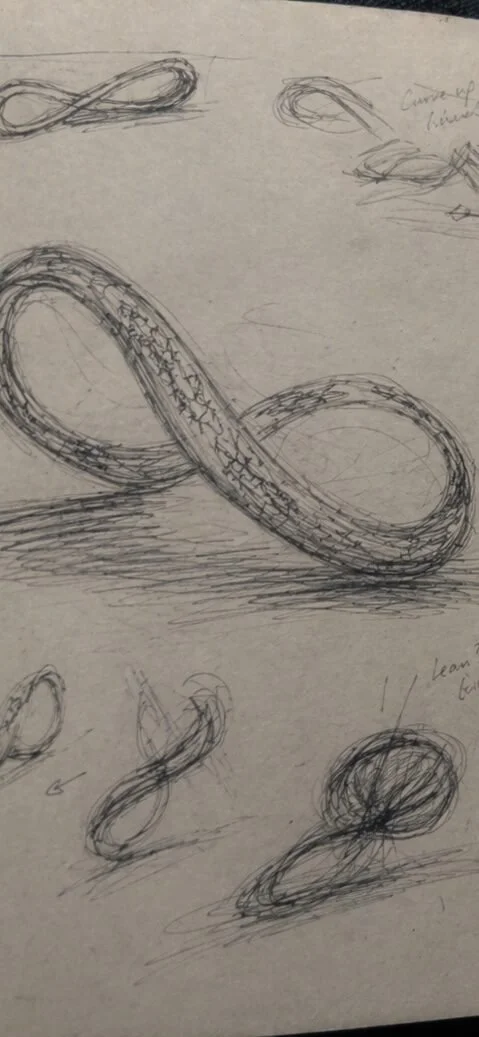
Möbius ring. Dual finish: one side gloss metal, the other etched. Koi fish? Dragon? Infinite flow. Yin and yang. Light, elegant, continuous.
Sketchbook notes
Stainless steel
The main version is in stainless steel. One face of the band is mirror polished and reflects the vines, the sky and the people standing around it. The other face is etched with my black and white photographs of koi, so the fish seem to swim around the loop and slip from the dark side into the reflective one.
From each position the sculpture shifts between image and reflection, between the fish and the landscape around them. It sits on a low plinth at a scale you walk around rather than look at.
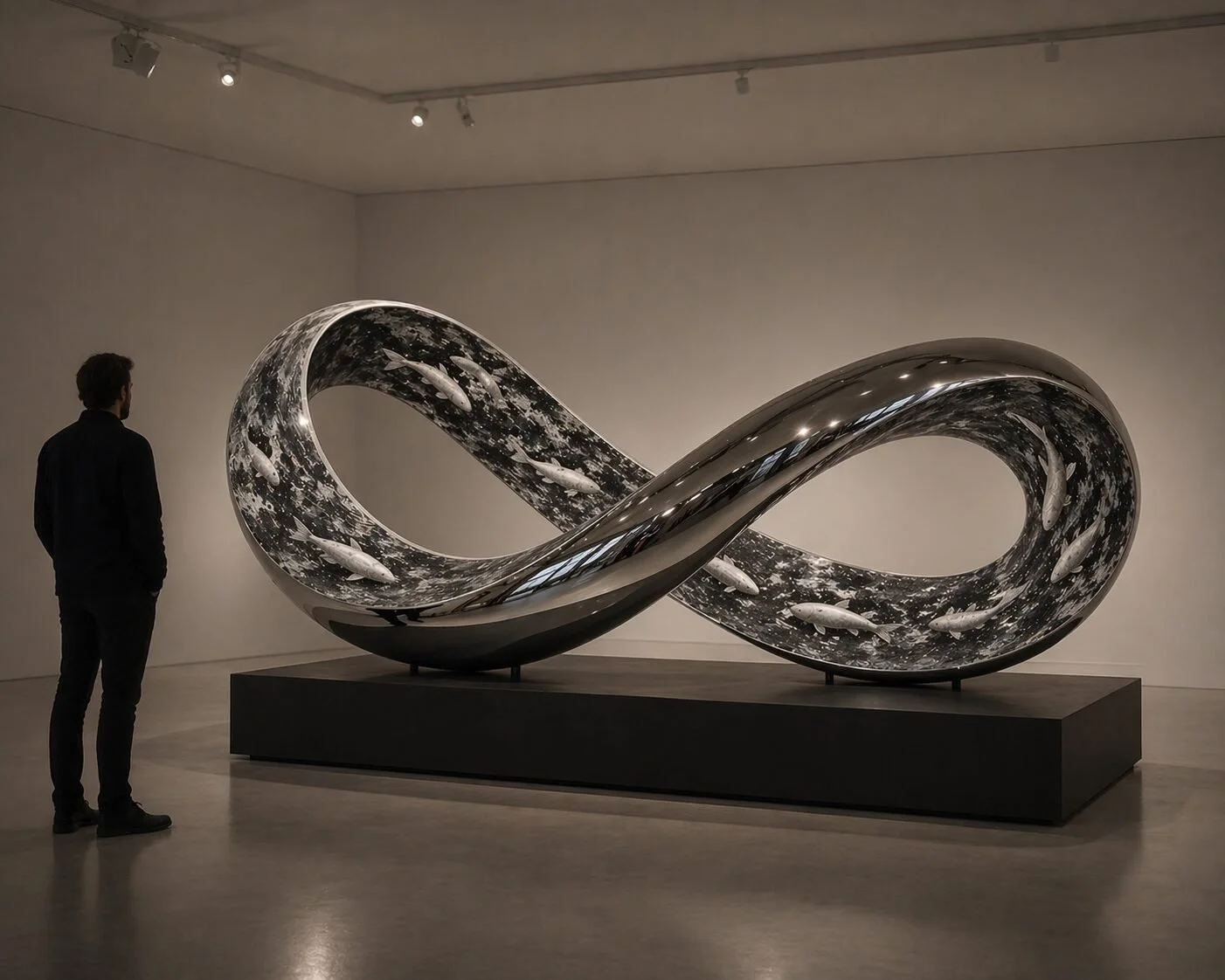
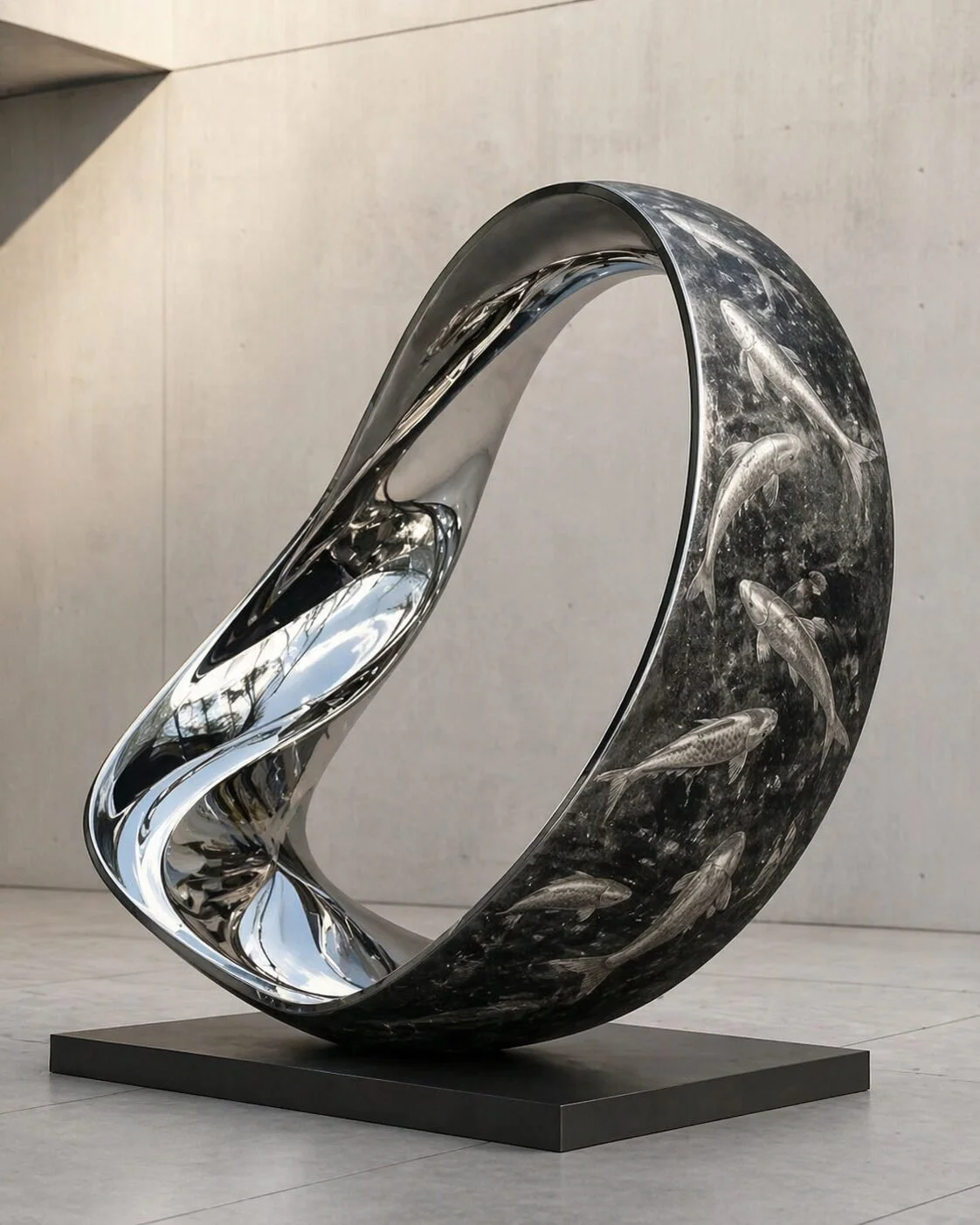
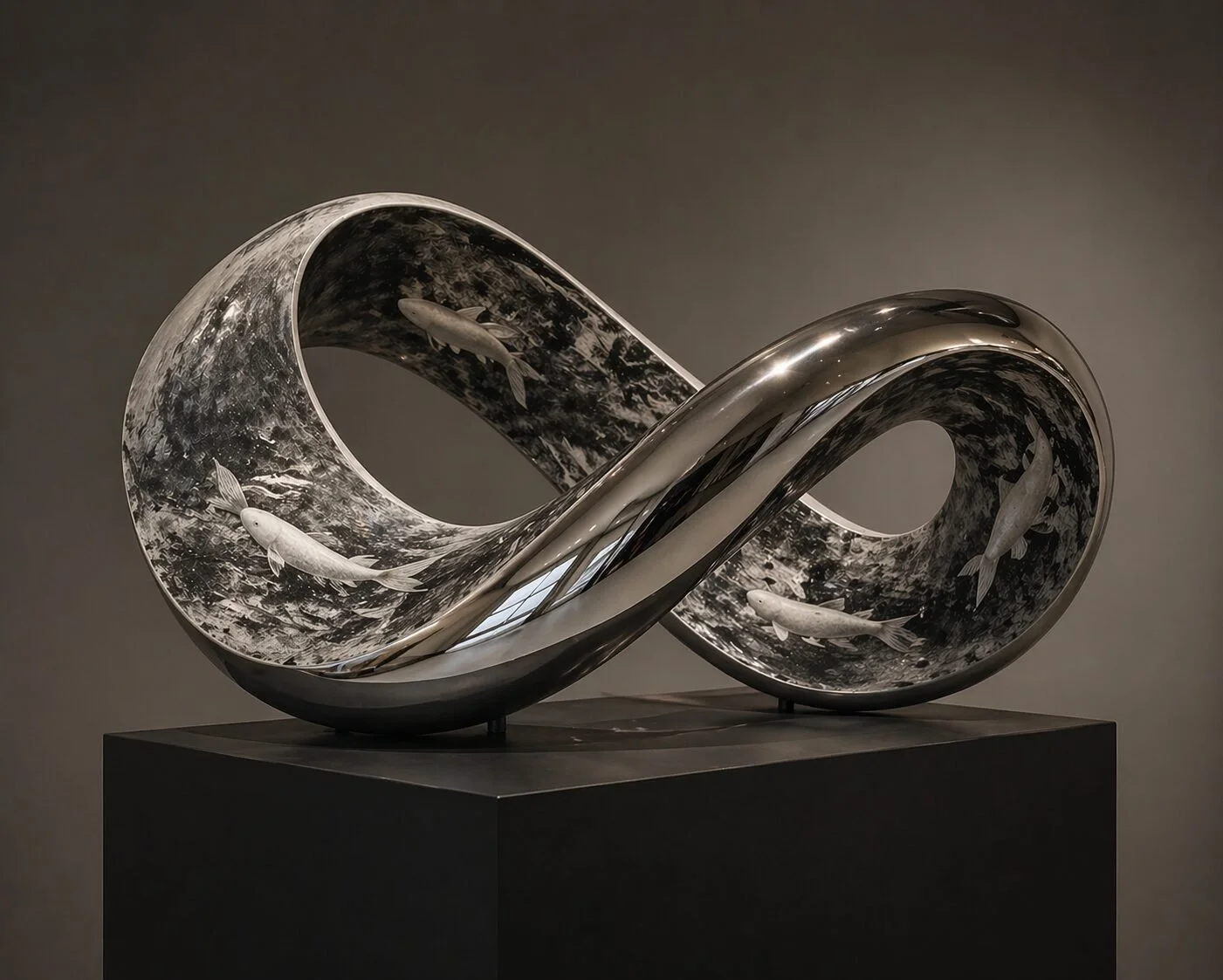
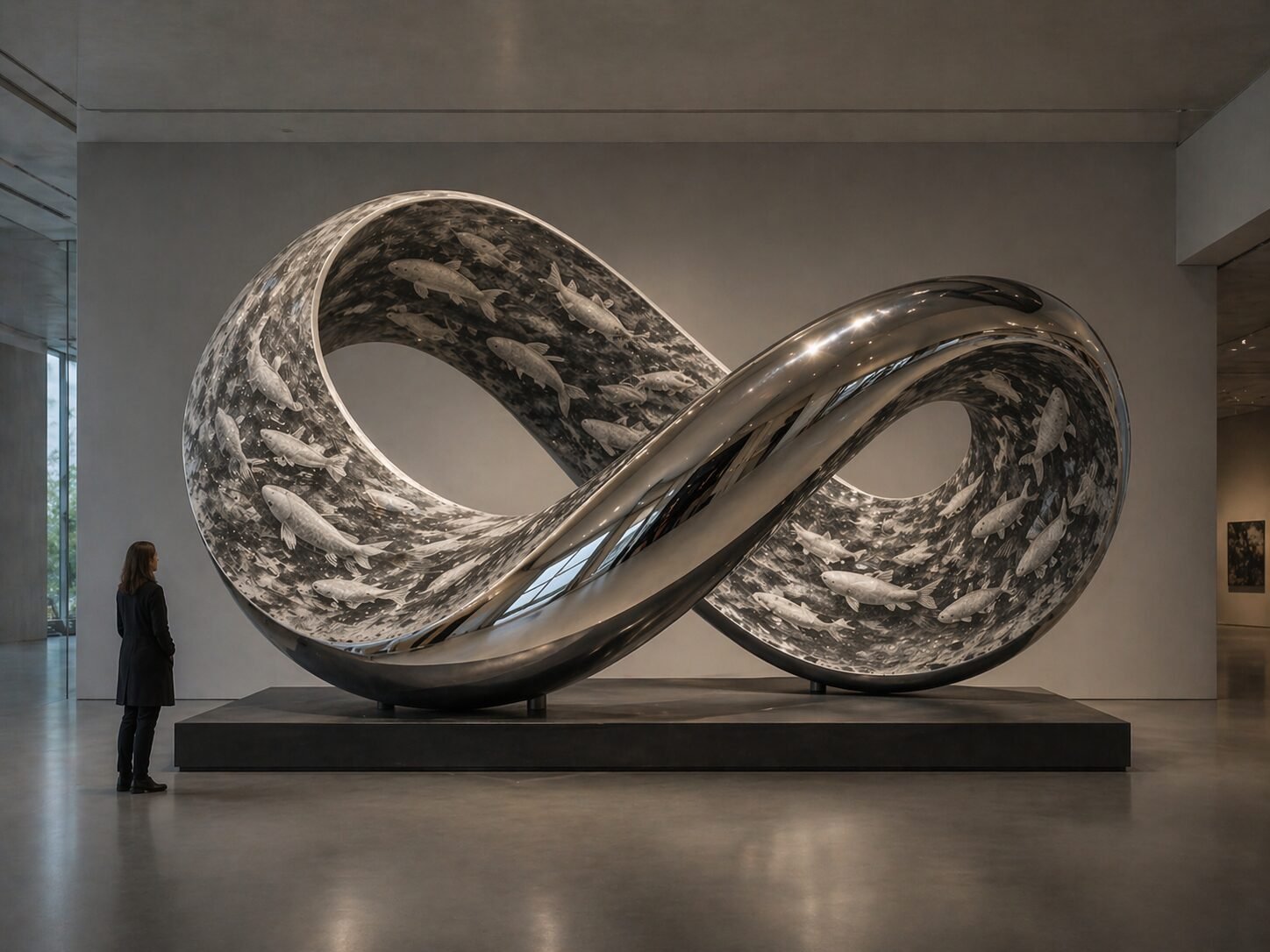
Design visualisations
Video sculpture
A second version turns the band into moving image. The surface is wrapped in LED screen, so video koi swim the length of the loop above a shallow pond where live koi move underneath. The real fish and the filmed ones follow the same path.
At night the sculpture becomes the light source, and it can play a sequence that traces the change from koi to dragon. The same form can also carry other footage, so the work can change with the seasons.
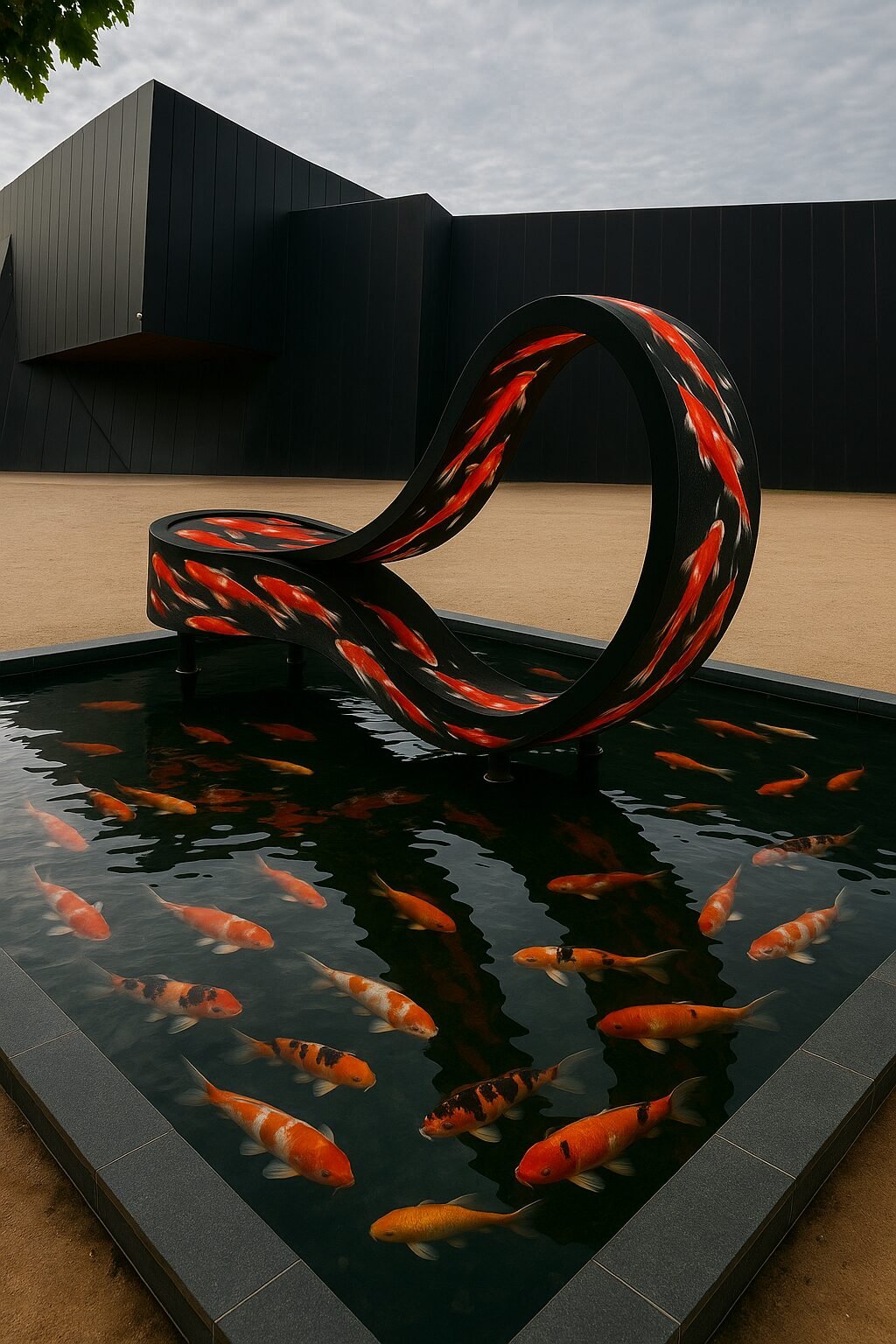
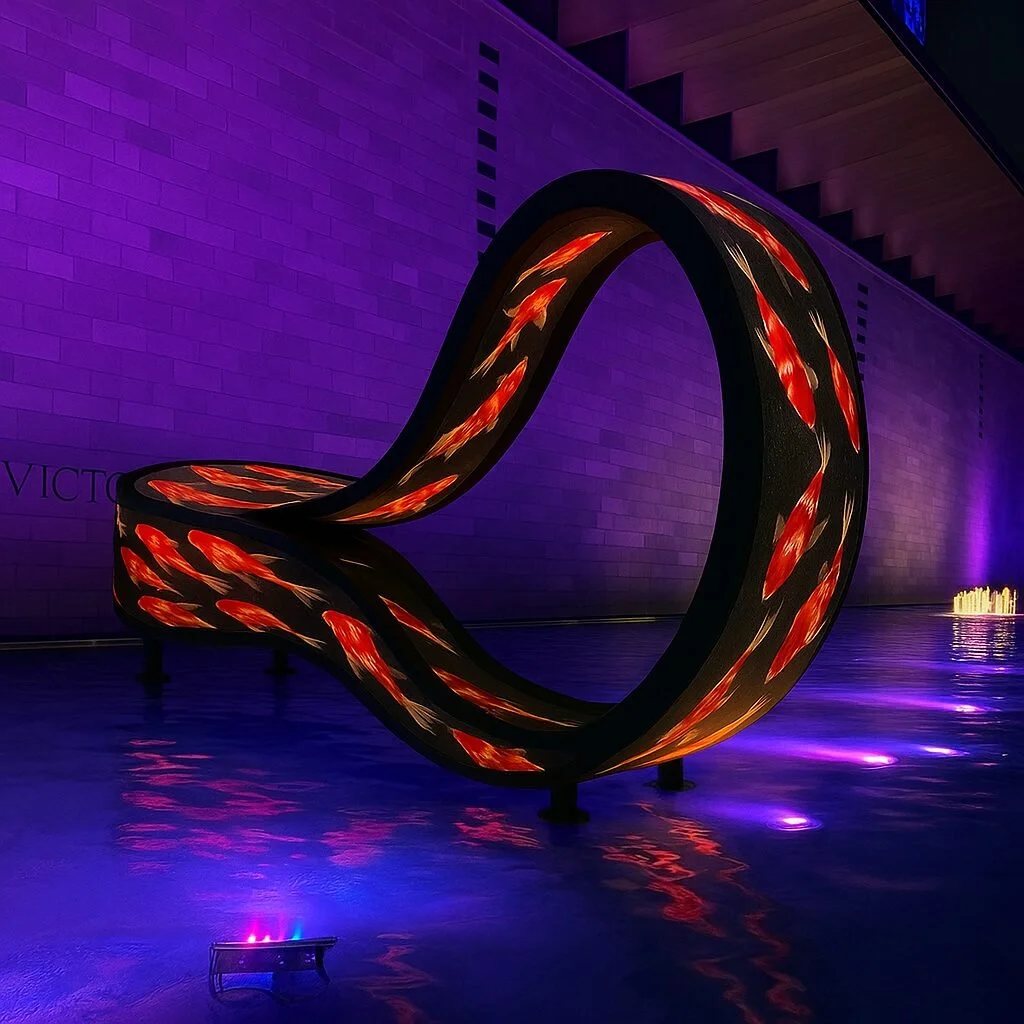
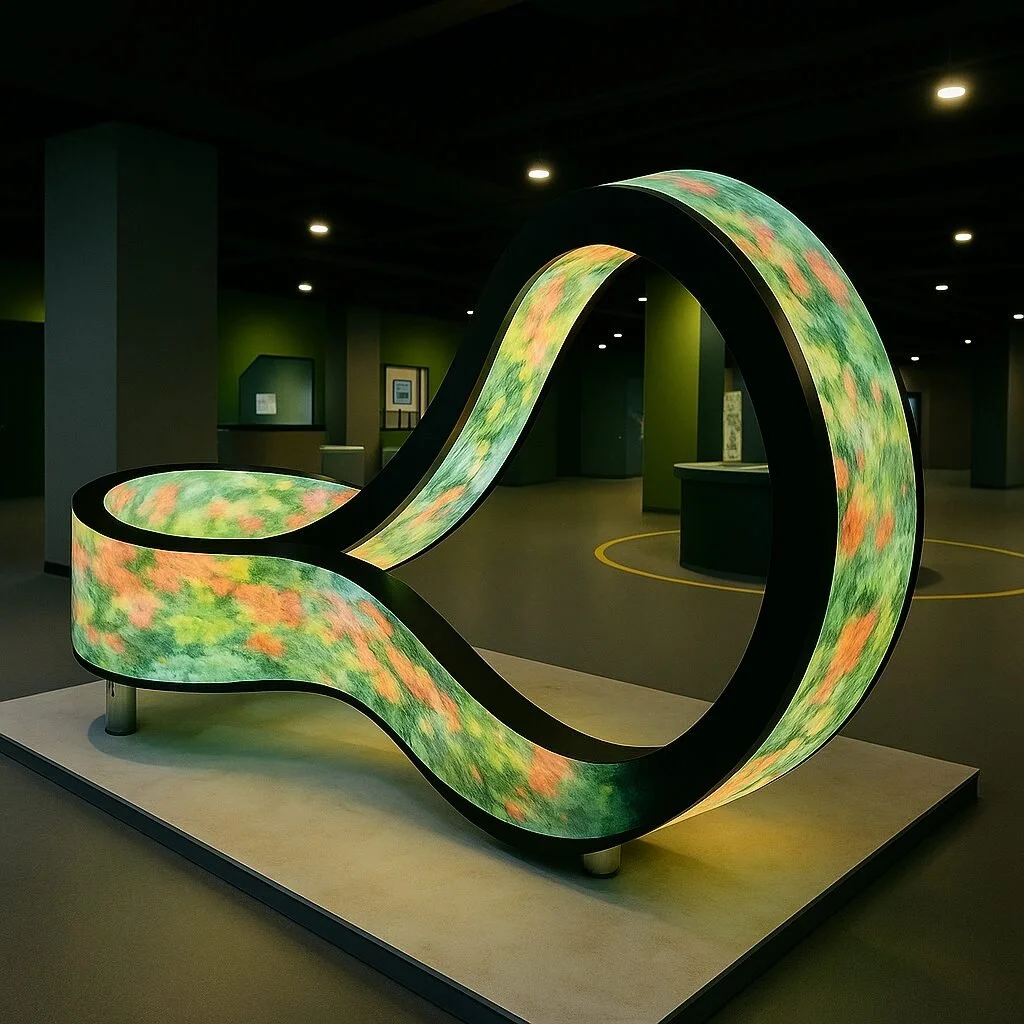
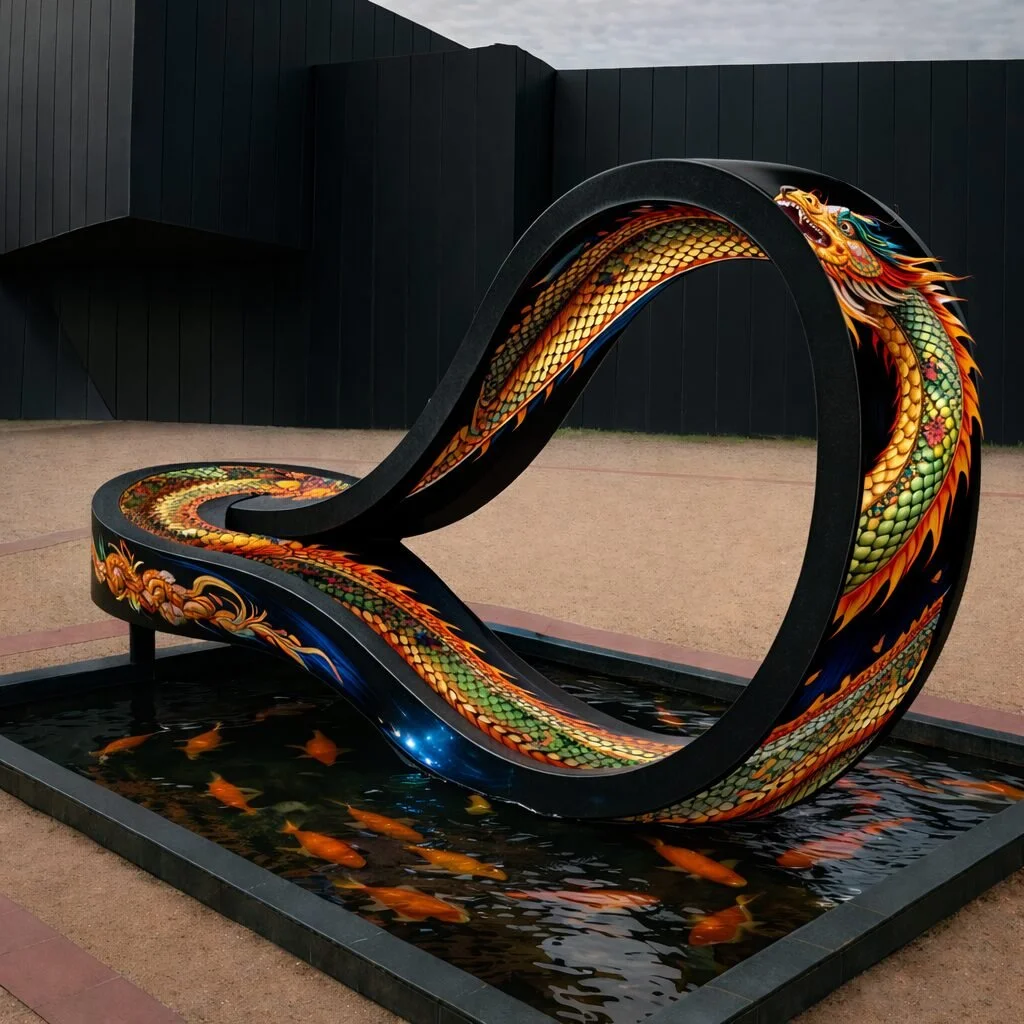
Design visualisations
Koi to Dragon is in development. The images here are sketches and design visualisations. Final material, scale and siting are being resolved with the estate.
The Garden

The Garden is an ongoing body of work that brings photography, sculpture, and digital methodologies into dialogue to explore how we encounter landscape through the body rather than through representation alone. Developed in Shanghai and shaped through sustained engagement with urban gardens, the series approaches the garden not as a motif, but as a condition—one that is inhabited, negotiated, and felt over time.
The works begin as photographic encounters made through slow movement and attentive walking. These images are then transformed through a hybrid process that combines AI collaboration, UV printing, and hand heat-forming acrylic. The resulting sculptural photographs resist flatness, occupying space as objects with posture, weight, and presence. Material is not forced into shape; it is listened to. Heat, gravity, and resistance play an active role in determining each work’s final form.
Across the series, different experiential states unfold—being held, wandering, floating, falling, longing—each offering a distinct mode of relation to landscape. Influenced by shanshui philosophy, phenomenological approaches to perception, and Daoist ideas of responsiveness and yielding, The Garden proposes an ethics of making grounded in attentiveness rather than mastery.
Works from The Garden have been exhibited internationally, including presentations at the West Bund Art & Design Fair in Shanghai, where key pieces were acquired by local collectors. The project continues to evolve through exhibitions, residencies, and academic research, expanding conversations around landscape, technology, and embodied experience.
A full project text, including contextual essays, work descriptions, and bilingual materials, is available as a downloadable PDF.


War Crimes

Made in response to scenes from Bucha in Ukraine. Russians made the local civilians wear white armbands to distinguish them from fighters/soldiers, they then used those same armbands to tie their hands before executing them.
While I work regularly in sculpture my background is photography and as such my approach to working with sculpture is informed by, and uses some of approaches and techniques from photography. The sculpture was made using a 3D scanning device. This was used to scan my partners hands bound with white cloth. A 3D model was then processed and printed using a 3D printer, the 3D print was then sculpted and worked on. An iron based rust paint was applied and oxidised. Finally the white armband/restraint was hand painted.
This is about a 1/3 scale maquette of the final. Due to the size of the 3D base I have access to it was better idea to work small for the test. The final will be printed as 3 or 4 sections and joined prior to sculpting & painting. The final result will be approx life size. I hope to exhibit this piece later in the year and it forms the basis for a larger installation I'm proposing.


‘Offshore Processing’

‘Offshore Processing’ , later renamed ‘Fair Dinkum Offshore Processing’ after a quote by the then Communications Minister Mitch Fifield
'Fair Dinkum Offshore Processing’ was made in response to how successive Australian governments, of both sides of the fence have decided to treat some of the most at risk and vulnerable people on the planet. From the lies and deceptions with 'children overboard', through to the establishment of 'camps' in other jurisdictions to the manipulation of immigration laws and zones, their behavior and the fact we let them get away with is shameful. The title comes from a 2011 quote from Mitch Fifield.†
While we may have a government we do not have any leadership. If we can't have leadership anymore, if it's true that the 24 hour news cycle, the obsession with opinion polls and emphasis on re-action rather than action is our reality, then I can only hope our 'governors' (they are NOT leaders) can see the change and 'react'. The death of Syrian toddler Alan Kurdi, the story of baby Asha and the #letthemstay campaign has signaled a shift in the general populous. If policy can't be changed can't for the right reason, by leaders who lead with their heart and heads, then let them do it to score a few percentage points in the latest round of popularity pageants.
My sculpture 'Offshore Processing' is a simple floating structure, a facility, cold and austere. It's made from galvanized steel, aluminum and razor wire. For security it has two, mains power independent, high power LED lights and its most important feature: no gate. Once you’re in, it's very hard to get out! Five figures stand rusting (corten steel) behind the fence.
I hope this sculpture will send a message to our politicians, raise awareness and hopefully raise funds* to change our direction as a nation and support the most vulnerable.
† http://www.mitchfifield.com/Media/MediaReleases/tabid/70/articleType/ArticleView/articleId/528/Transcript--Sky-News-AM-Agenda--19-December-2011.aspx

Lorne Sculpture Biennale 2016

Installed at Sculpture by the Sea - Tamarama beach

The work was also part of the 2016 Sculpture by the Sea, it was installed at Tamarama Beach.
Sculpture by (and in) the Sea
by Jo Litson on 24 October, 2016
Huge waves have damaged four sculptures and destroyed one at Sydney’s popular coastal exhibition.
Several sculptures in the hugely popular Sydney exhibition Sculpture by the Sea – a free display of more than 100 sculptures along the Bondi to Tamarama coastal walk – were damaged on Monday by a high tide and huge swell, as strong winds sent waves crashing to the shore.
Some artworks were swamped but survived. However, five were badly affected including Bronek Koxka’s Fair Dinkum Offshore Processing featuring figures in a metal cage, which was destroyed.


Development, construction and installation


But When I Became a Man (2012)

Much of my work looks at memory and remembered moments. In But When I Became a Man, I am looking at the toys and the games we must leave behind as we grow up. There is a realisation that the toy guns, the killing and the soldiers are wrong, but there is conflict too. These toys and memories associated with them are fun, and it is in this conflict that I find a sense of melancholy.
Here are some details and others that were part of this series


