
WROCLAW, UNEXPECTEDLY, June 2026
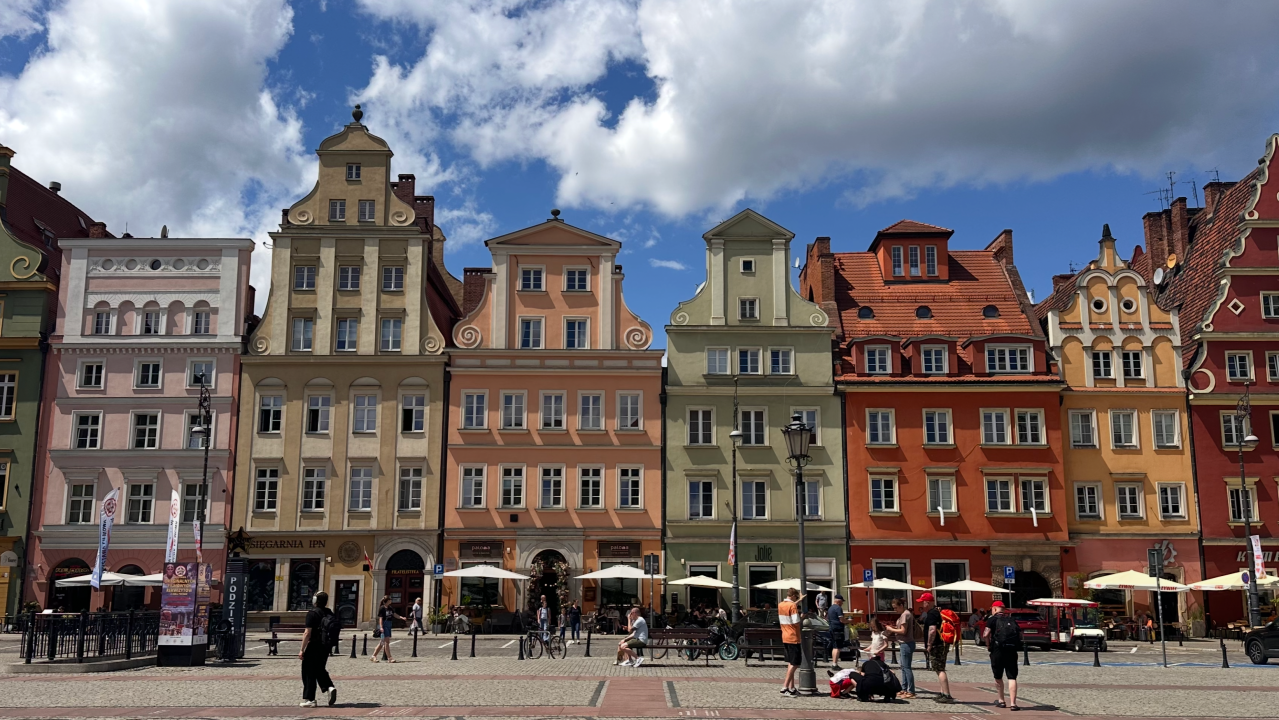
A day in the galleries of one of Central Europe's most vital art cities
I arrived in Wroclaw from Krakow, where I had spent a few absorbing days. Krakow was as it always is: layered, beautiful, slightly self-aware of its own historic weight. Wroclaw, when I had last visited years before, had felt different in character, looser somehow, more willing to surprise. I came back wanting simply to reacquaint myself with the city. I was not expecting to find a gallery scene as genuinely alive as what I encountered.
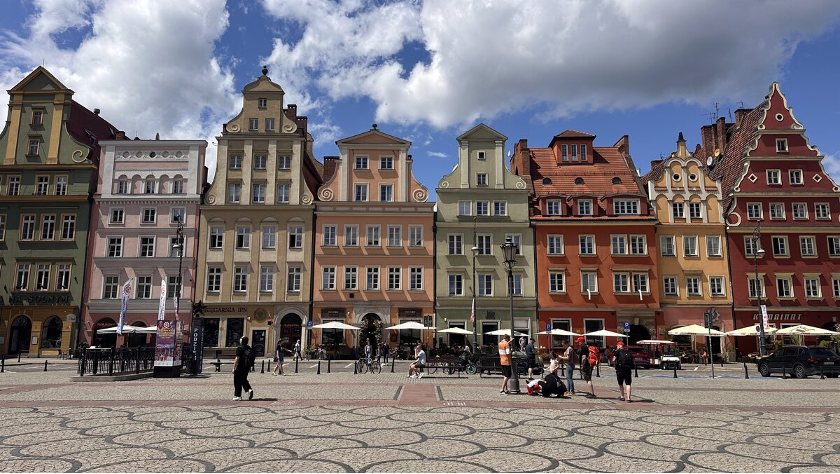
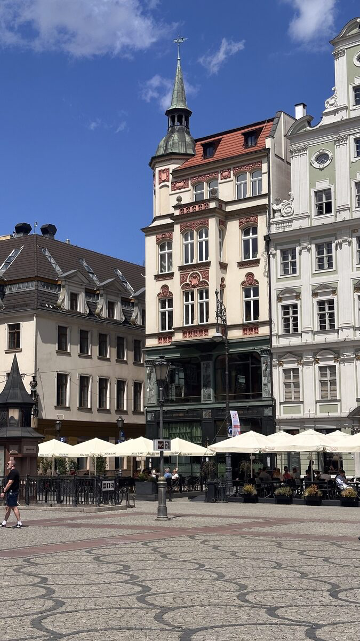
My last day there, I made a loose plan: four or five spaces, a walking route through the old town. What I found in those hours exceeded anything I had hoped for, and I left with the strong impression that there is something happening here that the wider art world has not yet caught up to. There are more galleries and spaces I did not manage to reach; what follows is what I did see, and what stayed with me.
SOLASTALGIA
Internets, Kebabs, Alcohols, Gravestones
Szymon Roginski at FOTO-GEN Galeria
FOTO-GEN Galeria sits in the old town, its interior divided between a clean white entrance gallery and a vaulted brick space that opens out below like a kind of urban cellar. Above the VR area, through the glass roof, you can read the FOTO-GEN GALERIA sign hanging against the sky. It was here that I encountered Szymon Roginski's SOLASTALGIA, an exhibition that had already claimed my attention before I stepped inside, simply because of its title.
The word was proposed in 2010 by Australian philosopher Glenn Albrecht to describe a very specific kind of grief: the distress caused not by leaving a familiar place, but by watching it change around you. Homesickness, but you have never left home. The landscape rewrites itself and you are left in a place that no longer quite corresponds to the one stored in your memory. Roginski applies this concept to contemporary Poland, and particularly to the small towns that have undergone the most dramatic transformation since 1989, not from wars or heavy industry, but from something more ordinary and therefore harder to argue against: roads, housing estates, phone masts, advertising, globalised commerce.
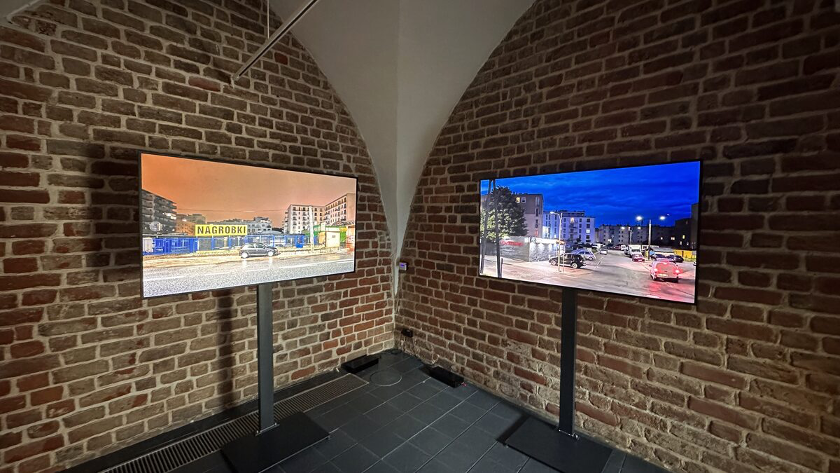
The exhibition structures this around four photographic series, each shown on monitors: Internets, Kebabs, Alcohols, Gravestones. The list reads like a vernacular inventory of what has arrived in provincial Poland over the past few decades and quietly rearranged everything. Roginski photographs with telephoto and wide-angle lenses and from drone altitude, shifting between the intimate and the panoramic. He is interested in both the emotional register of individuals and the cumulative, aerial picture of transformation that no single resident can see.
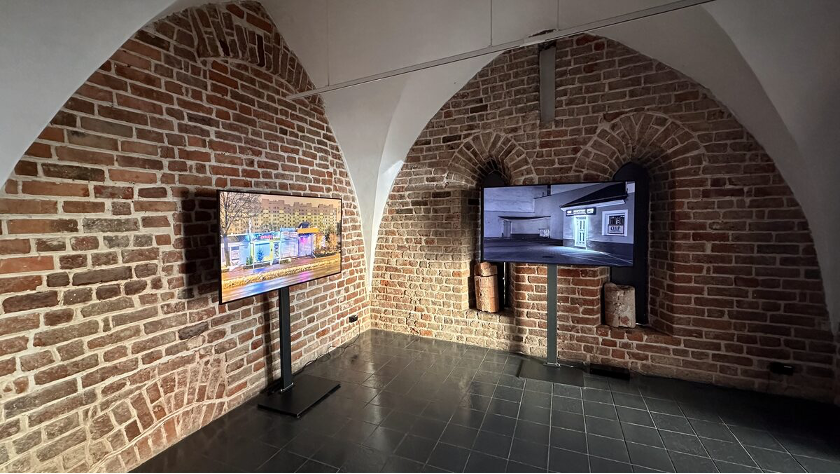
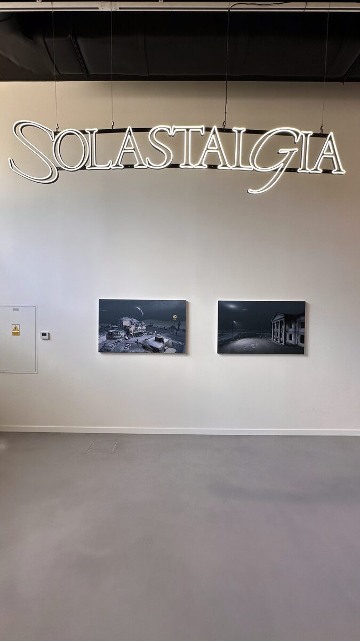
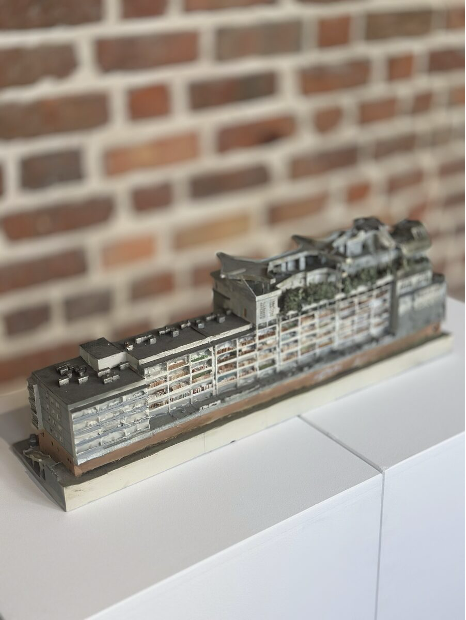
Alongside the monitor series, the exhibition includes a sound installation and three-dimensional sculptures: distorted architectural models derived from VR scans of real sites, accompanied by large expressive prints generated from within the virtual environment. These works complete a loop: reality is scanned into virtual space, which is then brought back into physical form, changed in the translation. The architecture emerges slightly wrong, compressed or stretched, like a memory that has been accessed too many times.
The VR component, also titled Solastalgia, was set up in a corner of the upper atrium on an ergonomic chair. I put the headset on. Inside, scanned landscapes of small Polish towns had been reconstructed and then subtly distorted, familiar enough to recognise as real places, strange enough to register as something other than documentation. You navigate through spaces that are both there and not there, places that existed as they were scanned and have continued to change since. It is a meditation on the impossibility of preserving a place even in data.
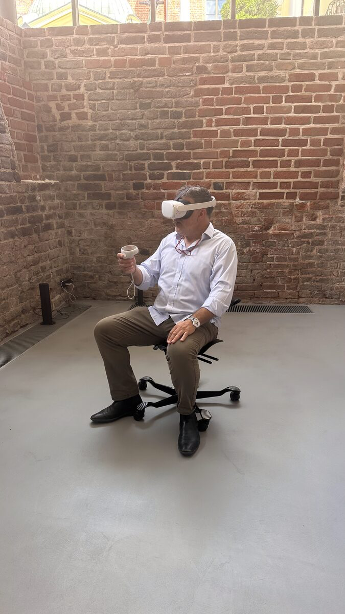
I stayed in longer than I expected. There is something about the medium that makes the solastalgia of the title literal rather than metaphorical: you are physically inside a landscape that no longer fully exists. For anyone working with questions of how places are documented, reconstructed, and experienced at a distance from reality, the show has an extra layer of resonance. Roginski approaches these questions through long-term documentary series and VR reconstruction; the underlying concern, about what it means to lose a landscape and how technology mediates that loss, runs through a great deal of practice that is nominally about different things.
SUPERUSER_DO
WRO Art Center
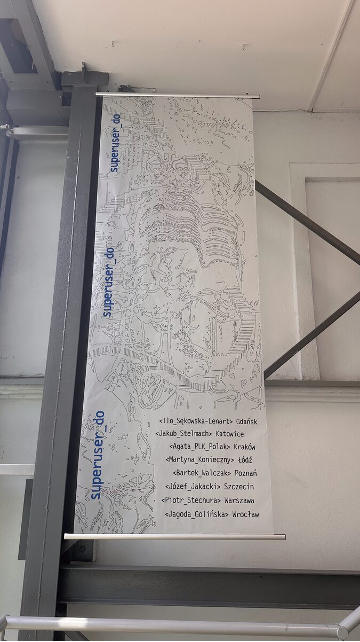
The WRO Art Center was showing a group exhibition of student work from the Jan Matejko Academy of Fine Arts in Krakow. Eight artists, each from a different Polish city, and the overall effect was of a generation working through genuinely urgent questions about technology, ecology, and the relationship between the two.
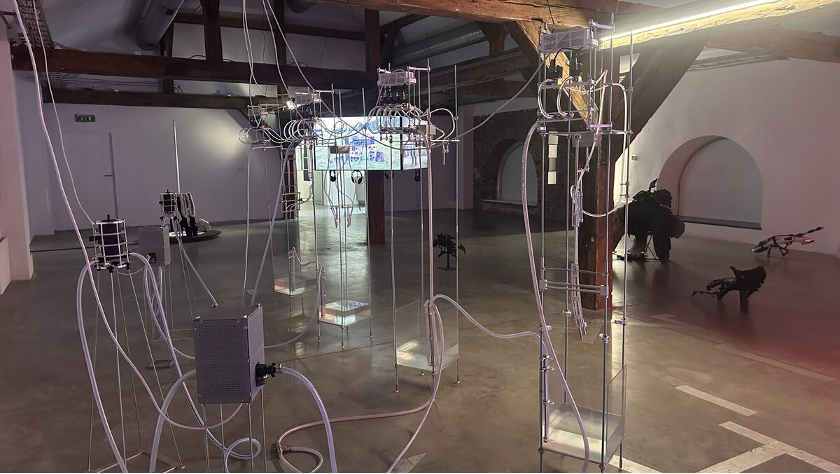
The main hall, a large barn-like space with exposed wooden beams and high ceilings, was given over to three installations that occupied the room together, each generating its own atmosphere while coexisting in a shared red-tinged light.
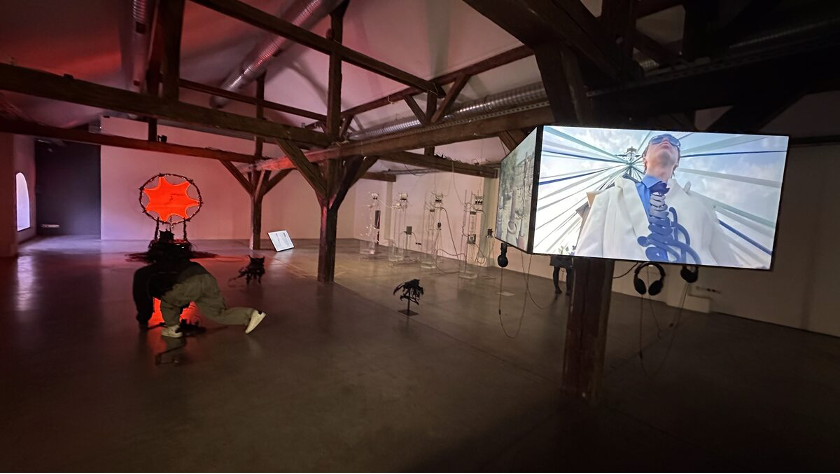
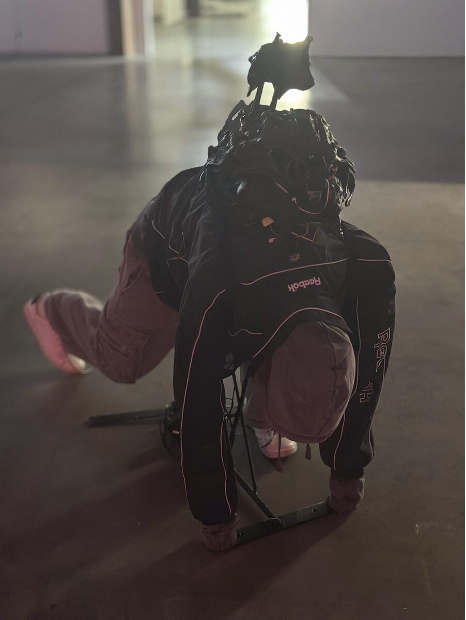
Piotr Stechura's Raceful Dead is built around a humanoid figure in a running start position, wearing a structure that resembles a backpack but which is made from fragments of motorcycles and scooters, designed and 3D printed entirely in resin. The work is interested in the tension between support and oppression in the relationship between humans and technology: structures designed as aids that over time begin to act as burdens, accumulating their own logic, imposing their own demands. The title references the Running Man motif from the 1987 animated anthology Neo Tokyo. The figure performs mechanical movements and emits sounds processed through an AI model.
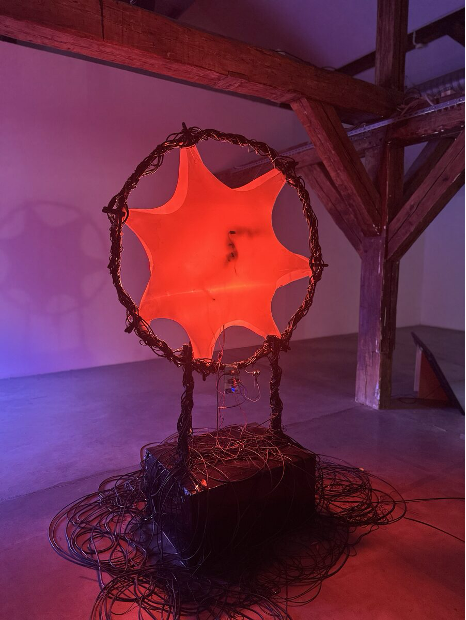
Jagoda Golinska's W Twojej skórze (In Your Skin) takes a different approach to a related question. At its core is a flexible membrane, circular, backlit in deep red, enclosed in a ring of wire and cabling. The membrane moves inward and outward, responding solely to the presence of a human body. The work is framed as a reflection on humanity's long desire to create artificial life, but also on the God complex embedded in that desire, the creator's claim to make autonomous beings while refusing to relinquish absolute power over what has been made.
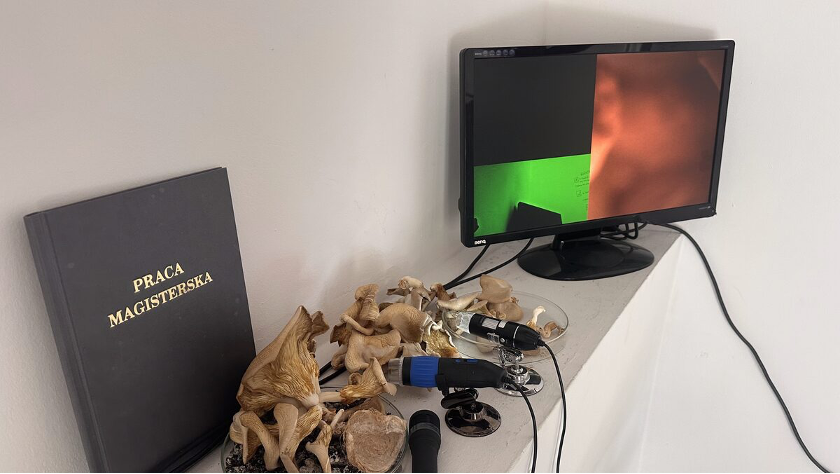
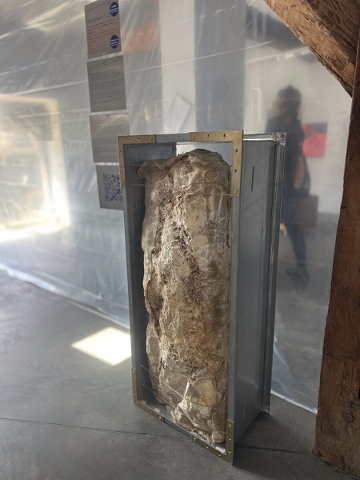
Agata PLK Polak's Mycosphere 3.0 occupied a large scaffolding structure threaded with mycelium connected to electronic systems converting biological signals into audible sound. It proposed something genuinely strange: that the communication structures of fungal networks might offer a model for rethinking how we build and understand digital networks. The combination of living biological matter, industrial scaffolding, and CCTV cameras gave the installation an uneasy, layered energy. The cameras created a surveillance atmosphere that sat in deliberate tension with the ecological optimism at the centre of the concept. Polak received both the 3P Studio Special Award and the Contemporary Lynx Editors' Award.
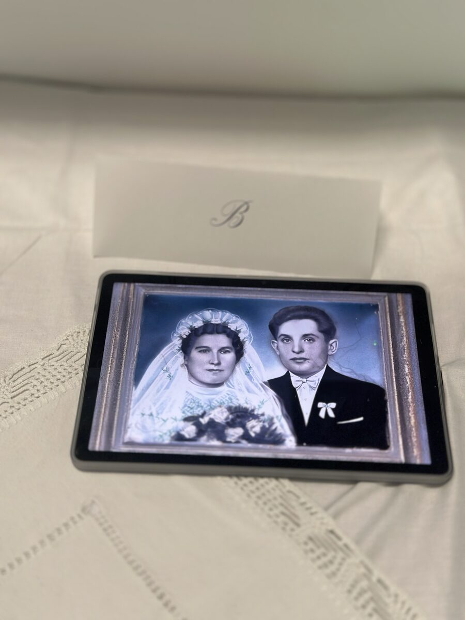
Ilo Sekowska-Lenart's Panstwo Mlodzi (The Newlyweds) occupied its own room arranged as a distorted 1990s Polish wedding hall: white tablecloths, white plates, gypsophila in small vases, and along three walls, monitors looping footage from the artist's family archive, her parents' actual wedding, with the faces of the bride and groom replaced using deepfake AI and the faces of all the guests obscured with black bars.
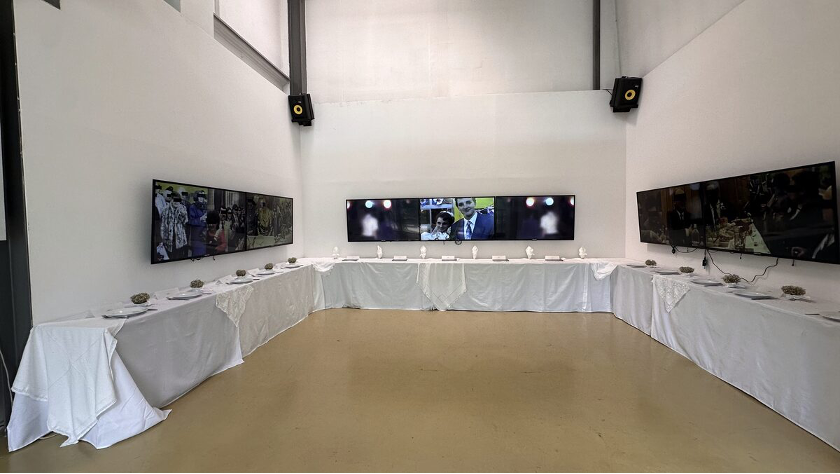
On the tables, instead of plates of food, are five small tablets, each displaying an AI-animated monidlo, a traditional portrait format, here drawn from virtual collections of cultural centres in Lesna Podlaska and Kadzidlo. These animated figures recite fragments of LGBTQ manifestos. By staging a tradition from which queer people are explicitly excluded, the work turns the wedding hall into a space that holds what that tradition refuses.
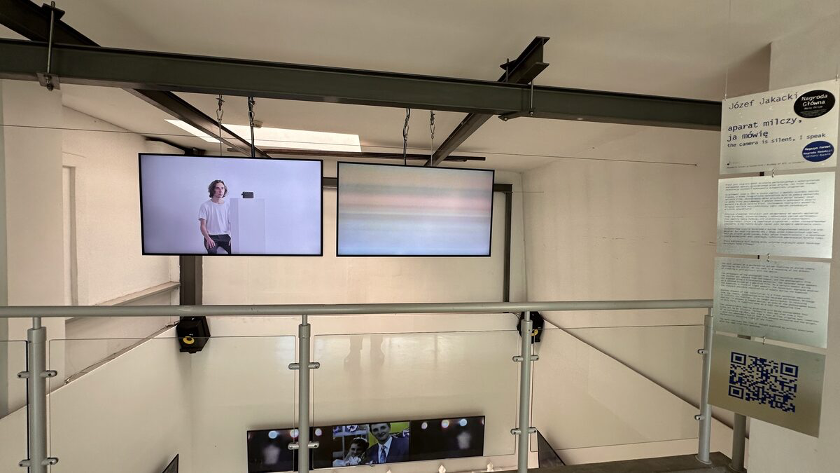
On the mezzanine level, Jozef Jakacki's aparat milczy, ja mowie (the camera is silent, I speak) presented two suspended screens alongside the modified camera at the centre of the work. Jakacki removed the shutter from an analog camera and exposed the film using the film-winding mechanism alone, producing images as colored streaks on positive film. A flash mechanism separated from the camera is synchronized with the recorded performance: it no longer captures reality but echoes the photographed event, operating as a looped device measuring time. Jakacki won the Magazyn Format Editors Award for the work.
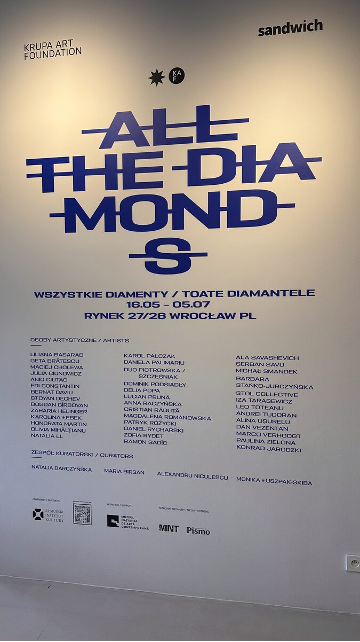
ALL THE DIAMONDS
Wszystkie Diamenty / Toate Diamantele
Krupa Art Foundation
The Krupa Art Foundation was the most substantial stop of the day, and the one I had least anticipated. The main exhibition, All the Diamonds / Wszystkie Diamenty / Toate Diamantele, brought together artists from Poland, Romania, and beyond, and it had the unmistakable feel of a deeply considered curatorial project rather than a survey. The three-language title signals the exhibition's core axis: a sustained conversation between Polish and Romanian contemporary art.
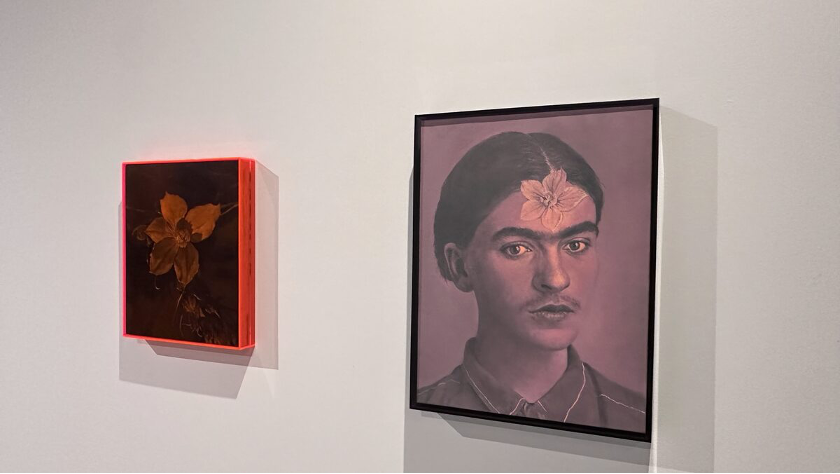
The Romanian painter Andrei Tudoran opened the show, in the sense that his work was among the first I encountered. His two paintings, both titled Viva la Vida after the Frida Kahlo series of late watermelons, approach painting's deliberate slowness as a form of resistance. One is oil on wood from 2025, the other on canvas from 2026; both are small, almost intimate, dealing with the fragility of constructs, social and economic and political, that Kahlo's life and work both reflected and challenged.
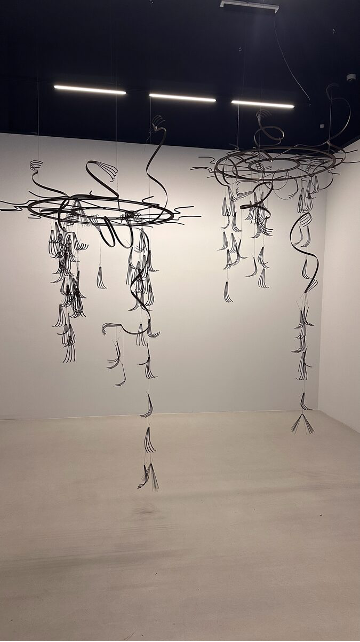
Iza Tarasewicz's Looped Processions I (2022) was one of the exhibition's genuinely commanding works. Two pieces in oxidised steel and wire, each about a metre high and over a metre in diameter, the forms describe a choreography rooted in communal labour, invoking the mazurka while engaging with philosopher Raymond Tallis's theory of the human thumb as the anatomical foundation of complex tool use.
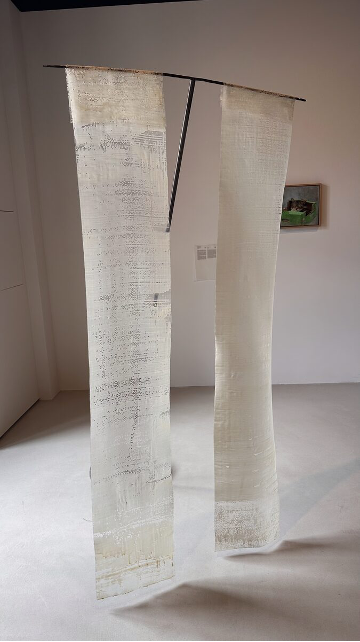
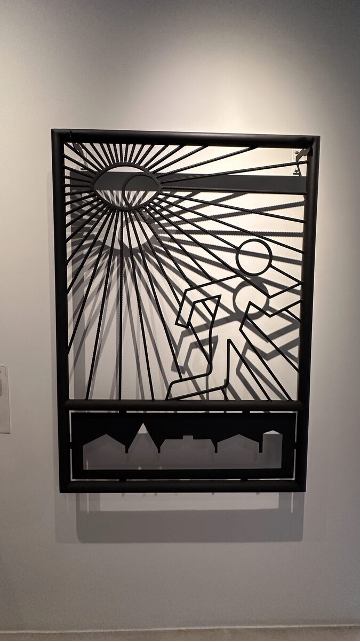
Karolina Lebek's Plexus (2024): two large white textile panels woven from grasses and wildflowers using traditional methods. Maciej Cholewa's steel gate, The Gate for all of those who left small towns and gone to Warsaw (2019), carried the full weight of what the title describes: vernacular county-town metalwork charged with the mass internal migration of young Poles toward the capital, what Cholewa calls "Poland B."
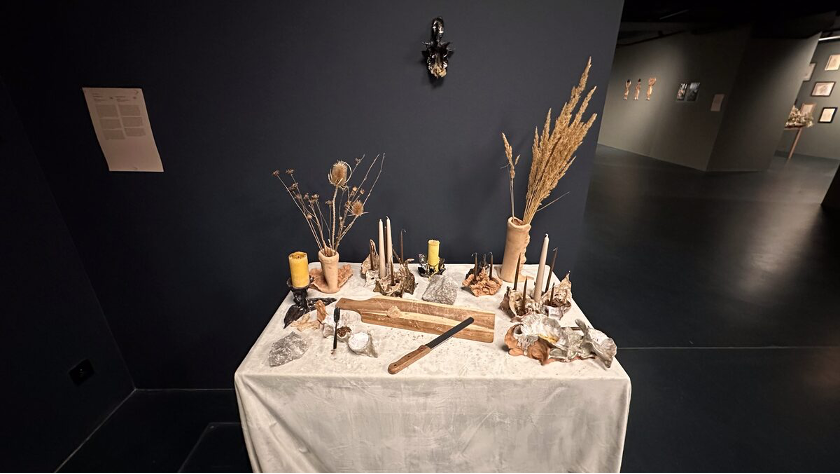
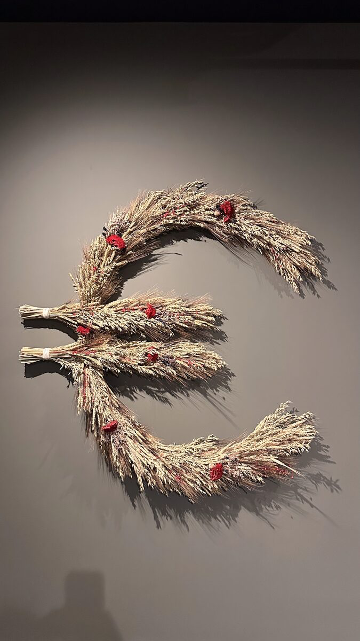
Anio Ciutac's Bread and Salt (2025) shaped a Romanian tradition of offering bread and salt to guests into a ceramic and textile altar arrangement. Anna Raczynska's Future Primitive (2021) made a euro sign from bundled wheat, wildflowers, and hay: the symbol is recognisable at once, the materials complicate that recognition immediately.
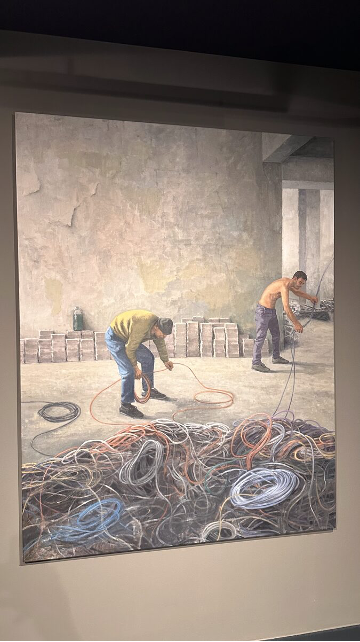
Serban Savu's Father and Son SS/P 21111 (2021), a large oil on canvas at 195 by 150 centimetres from the Krupa Collection, anchored the final room. Savu works in pseudo-documentary realism; cables are a recurring motif in his paintings of the Romanian landscape, and here they anchor a melancholic narrative about the collapse of empire.
NA NAS JUZ CZAS
It's Time for Us
KAF Project Space — Pawel Althamer and Artur Zmijewski
Through a door at the back of the main foundation space, a sign read: "behind these doors intuition awaits." The KAF Project Space hosted Na nas juz czas / It's Time for Us, a joint exhibition by Pawel Althamer and Artur Zmijewski, two artists whose decades-long collaboration is one of the defining working relationships in Polish contemporary art.
Althamer's figures, made from organic and found materials, have always had something uncanny about them, a sense of being inhabited in ways conventional sculpture is not. The standing figure near the entrance had this quality; so did the two recumbent forms lying in coffin-like strucWEAtures.
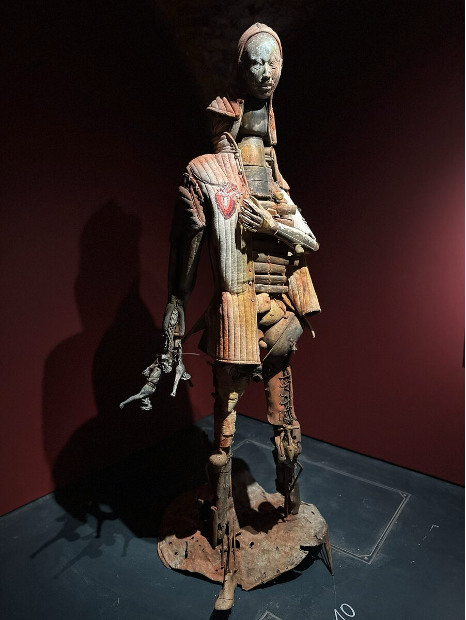
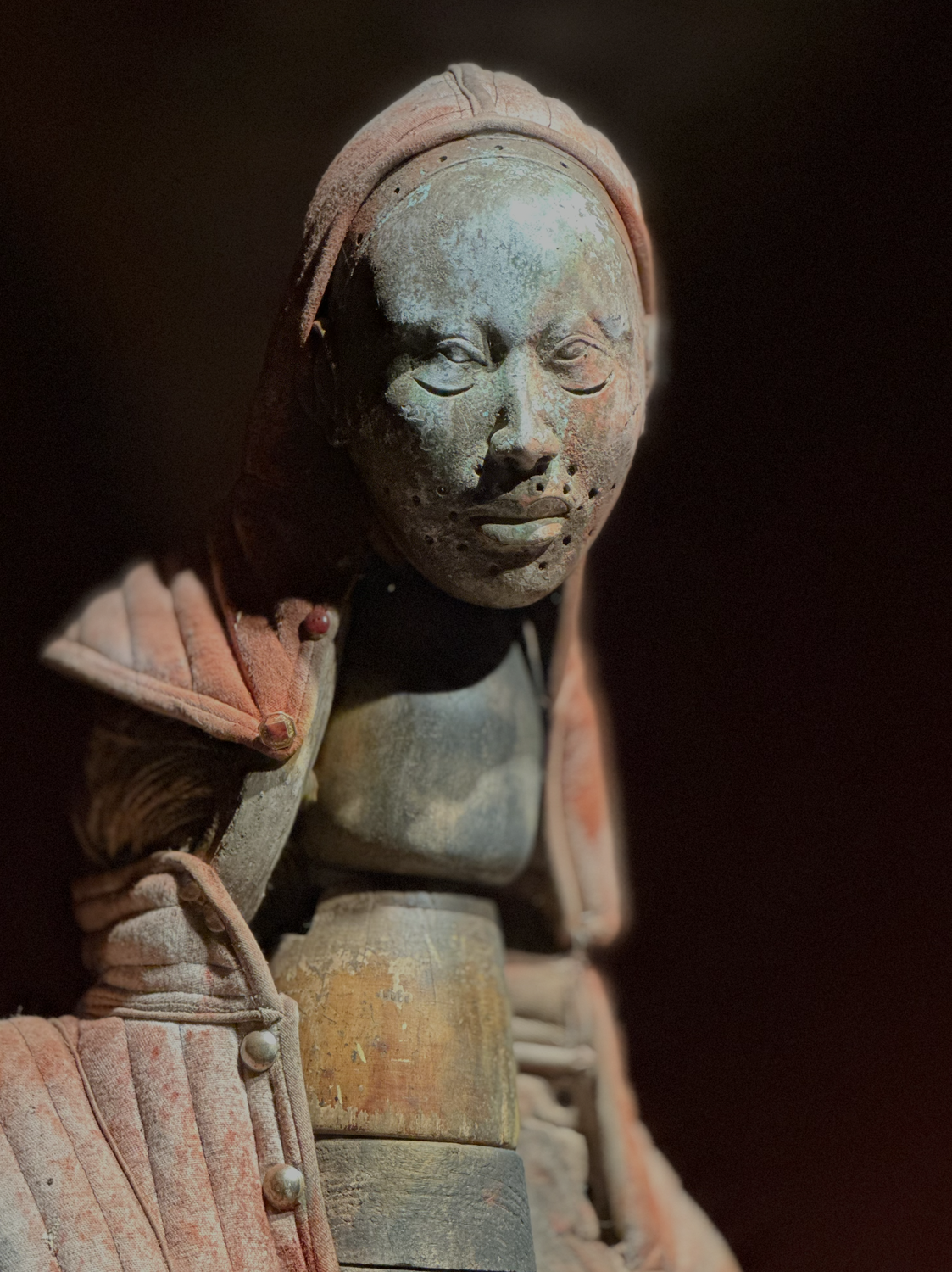
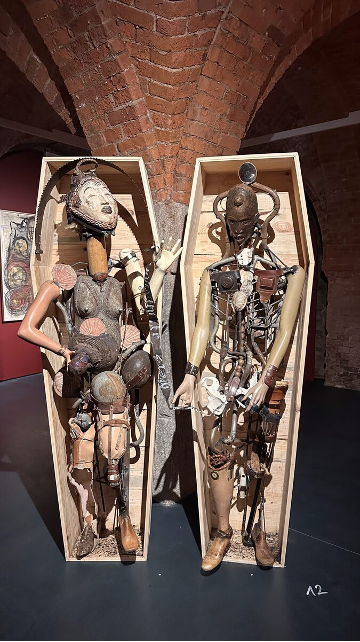
WHE anY given piece was by Althamer, Zmijewski, or somewhere between them was deliberately ambiguous. That ambiguity is part of the collaboration.
ANOTHER PLANET ENTIRELY
Muzeum Wspolczesne Wroclaw
The Muzeum Wspolczesne Wroclaw is housed in a building that earns its own paragraph. Originally constructed in 1942 as an anti-aircraft shelter, the six-storey cylindrical structure sits on a circular plan some 31 metres in diameter. Its reinforced concrete walls are over a metre thick. The corridors radiate outward from a central staircase like the passageways of an unusual machine, and this geometry shapes every exhibition held within it. You are never entirely unaware that you are inside a structure that was built to outlast bombardment.
Marco Angelini's solo exhibition made direct use of this context. Angelini works with solar energy as both subject and material, and the show moved between painted canvases, lightbox installations, and works incorporating actual photovoltaic cells.
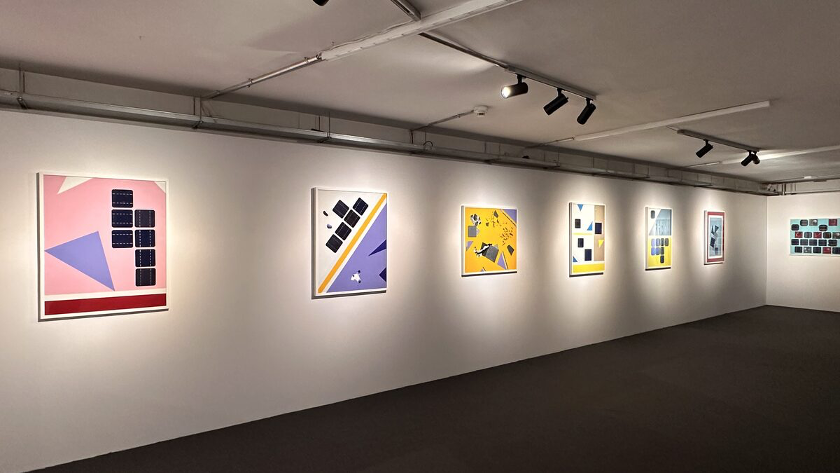
The largest room held a sequence of geometric canvases in vivid colour combinations: pink and violet, yellow and navy, each featuring solar panel cells as the primary compositional element. Painted with precision and a flat boldness, they feel somewhere between the Constructivists and a graphic language specific to contemporary energy infrastructure. They are paintings about technology, but they are also, formally, very good paintings.
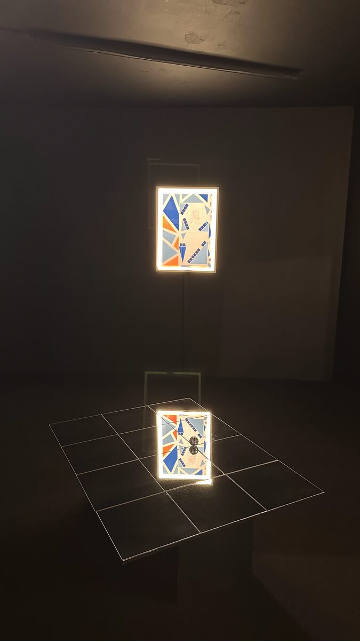
A smaller, darker room held the lightbox works. A Friend from South America (2021) is a lightbox incorporating medical X-rays of knee joints, over which Angelini has poured fluid pigment in blues and browns. The Spanish text "de pie," meaning "standing," is visible on the X-ray plate.
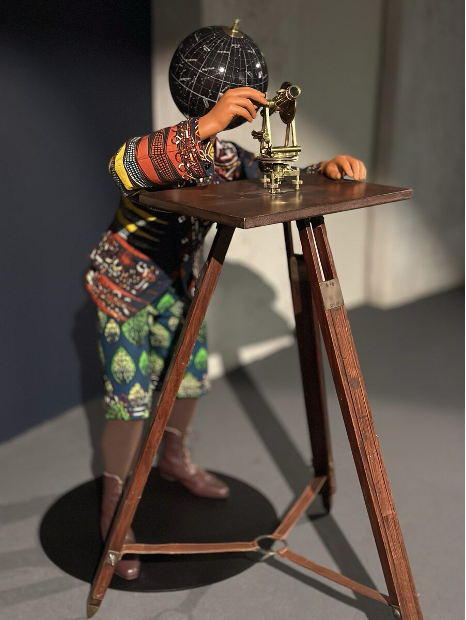
Yinka Shonibare's Planets in My Head, Young Geologist (2019) occupied its own room with the presence of something that knows exactly what it is. A fiberglass mannequin dressed in Dutch wax-print batik fabric, the head replaced by a dark globe mapped with constellations named after significant geologists, the figure leans over a Victorian theodolite on a tripod. The object is dense with the layered ironies that characterise Shonibare's practice: the batik fabric produced in Indonesia, sold in the Netherlands, and associated in the Western imagination with West Africa. The globe itself was made by Bellerby in London.
Elsewhere in the building, Laboratorium Barw presented Indigo, a collaborative installation by Patrycja Mastej and Magdalena Skowronska. The project takes individual colours as the basis for immersive sensory environments, and the room dedicated to indigo was organised around the following register: intuition, insight, perception, vision, dream, imagination, the invisible, inner clarity, self-awareness. These are not properties of the colour so much as states the colour is supposed to facilitate. It positions itself as an exposure rather than a display, a room you enter in order to have an experience shaped by indigo rather than to look at something described by it.
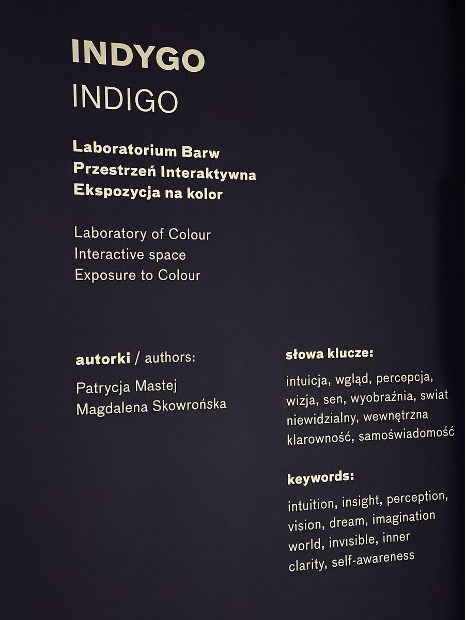
Laboratorium Barw: Indigo. Exhibition caption. Patrycja Mastej and Magdalena Skowronska. Muzeum Wspolczesne Wroclaw.
The final space I entered at the museum was a room that stopped me at the threshold. A UV blacklight installation covered every surface of one of the building's cylindrical tunnel spaces: the curved walls entirely given over to a mural in UV-reactive paint, featuring eyes, jellyfish-like forms, wings, hands, spirals, and coral-like branches assembled from a vocabulary somewhere between the microscopic and the cosmic. Circular platforms on the floor were painted with geometric grid patterns and central eye motifs. A cluster of mirror balls hung from the ceiling and scattered reflected light across everything. I could not find a caption identifying the artist. But the experience of the room was one of the strongest single installations I encountered in some time.
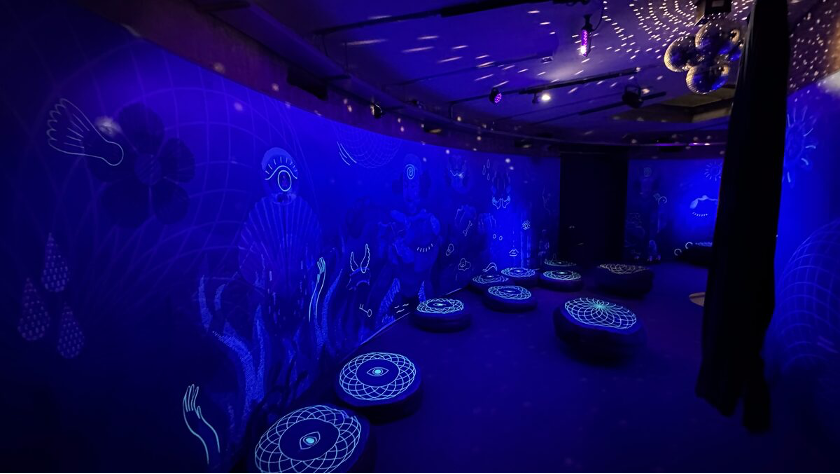
UV blacklight installation, installation view. Muzeum Wspolczesne Wroclaw. Artist unconfirmed.
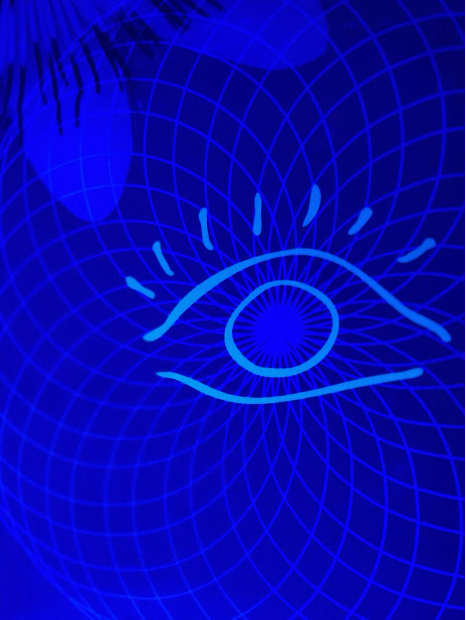
UV blacklight installation, detail: floor platform with eye motif and mirror ball reflections. Muzeum Wspolczesne Wroclaw.
AFTERWARDS
By the time I left the Muzeum Wspolczesne Wroclaw it was late afternoon. I walked back through the old town and found myself thinking that this is exactly the kind of city that rewards a day spent in galleries. Not a single landmark, not a programme of monuments, but a circuit of spaces paying serious attention to what art can do and say right now.
Wroclaw has an unusual history, even by Central European standards: German until 1945, Polish thereafter, the population transferred, the name changed, the architecture preserved partly by choice and partly by the effort of rebuilding from rubble. A city acutely aware of how cultures and identities are constructed rather than simply given. It may be no accident that the exhibitions I saw were preoccupied with exactly these questions: what we carry, what gets lost in translation, who owns a symbol, what labour means, who the future is for, and what it feels like when the landscape you grew up in is quietly replaced by something you did not choose.
I did not see everything. There are galleries and spaces I did not reach. What I did see was enough to make clear that a return visit, with more time and better planning, is not optional.
Wroclaw, June 2026