
Moving Image
This page contains moving image components from several different series and bodies of work.
Working with Scaniverse & Meta Quest 3
Into the Scaniverse: Sharing Presence on Meta Quest 3
The question of how to share these scanned environments has always been central to the work. A print can travel, a video can stream, but neither delivers the embodied experience of being inside the data. The development of Scaniverse and its companion app, Into the Scaniverse, has transformed what is possible.
The Platform
Scaniverse is a free application available for iOS and Android that enables the capture of Gaussian splat scans using a smartphone. Into the Scaniverse extends this ecosystem to the Meta Quest 3 headset, allowing users to step inside their own scans or explore a global map of publicly shared environments. For my practice, this combination of accessible capture technology and immersive playback represents a significant shift: the scans I create can now be experienced by anyone with access to a Quest 3 headset, anywhere in the world.
The Workflow
The process begins with capture. Using the Scaniverse app on my phone, I move slowly through a space, allowing the software to build a three-dimensional model from multiple viewpoints. This is the same deliberate, attention-rich process described earlier: walking, circling, returning, accumulating data through movement. The app processes the scan locally on the device, converting raw capture into a navigable Gaussian splat.
Once processed, I can upload the scan to the Scaniverse map, making it publicly accessible, or keep it private for controlled sharing. The scan exists in the cloud, independent of my phone, ready to be accessed from any compatible device.
On the Meta Quest 3, the Into the Scaniverse app provides access to this library. Viewers can browse a global map of user-created scans, visiting places they have never been: Stonehenge, street art in distant cities, domestic interiors, natural landscapes. Or they can step directly into scans I have shared, entering the specific environments I have captured and shaped.
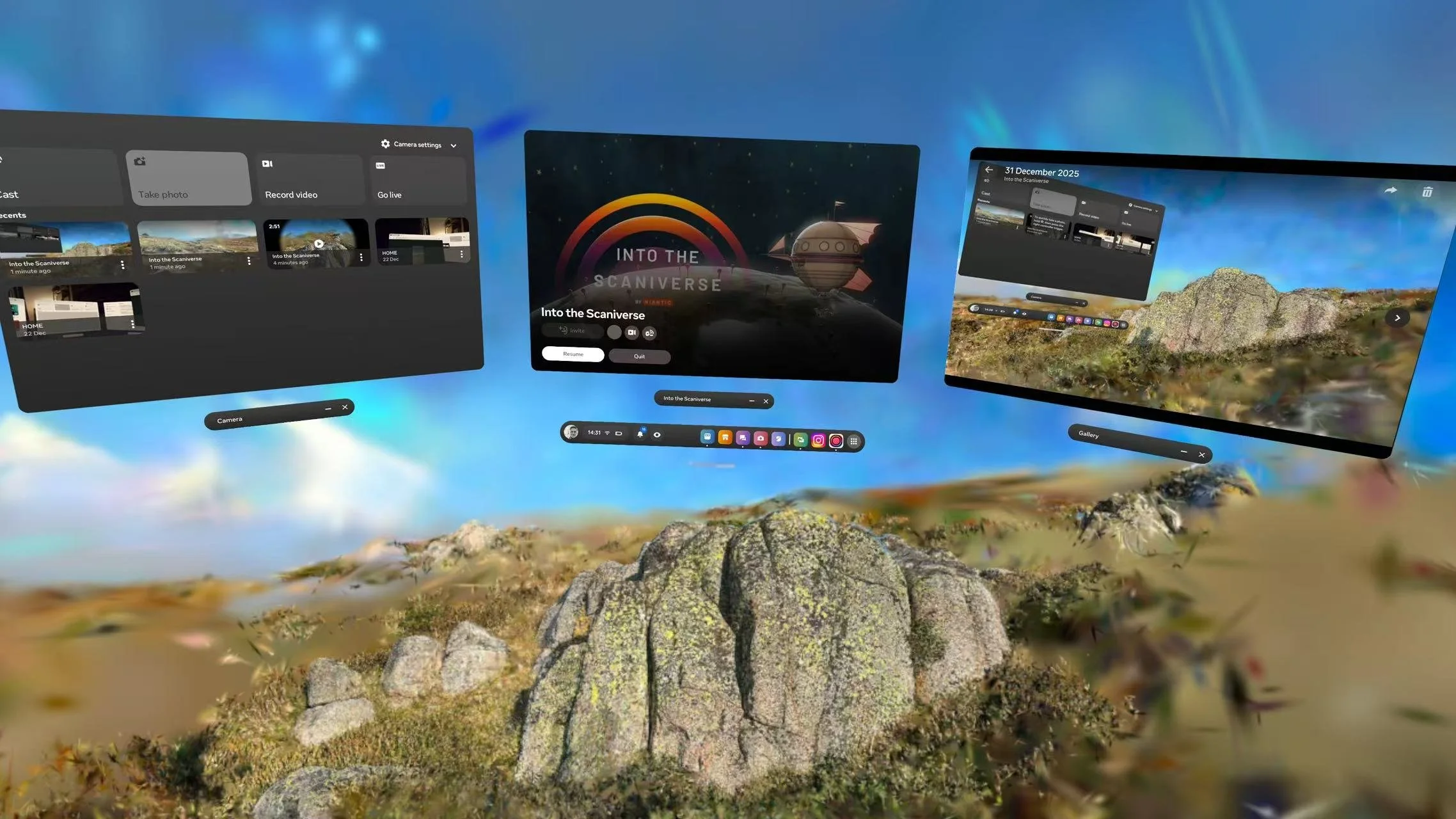
screenshot from in Meta Quest world
The Technology: Gaussian Splatting
Gaussian splatting represents a significant advance in three-dimensional representation. Unlike older methods that construct surfaces from polygons or rely on dense point clouds, Gaussian splats model scenes using overlapping three-dimensional gradients that capture both geometry and lighting with remarkable fidelity. The result is an environment that feels continuous rather than fragmented, soft rather than angular, present rather than schematic. The technology disappears into the experience.
A New Way to Share Place
What distinguishes this platform from other forms of virtual experience is the origin of the data. These are not constructed environments, designed and rendered by artists working from imagination. They are translations of actual places, captured through my physical presence and movement. When you stand inside the scan, you stand where I stood. The light you see is light I recorded. The ground beneath your virtual feet is ground I walked across, phone in hand, attending to every surface.
Scaniverse describes its platform as offering "a new way to experience travel and memories in 3D." For my practice, it offers something more specific: a means of sharing presence. The scans I create are not souvenirs or documents. They are invitations to inhabit, however briefly, the places and moments I have attended to.
This changes the relationship between artist and audience. The scan becomes a gift of access, a portal opened between my experience and yours. You cannot touch the soil or smell the air, but you can occupy the space, move through it with your own body, develop your own relationship to its forms and textures.
Into the Scaniverse makes this exchange possible at scale. Anyone with a Quest 3 headset can access the work. The barrier to entry is low; the depth of encounter is as rich as the viewer chooses to make it. In this sense, the platform fulfils a longstanding ambition of the project: to move beyond spectatorship toward genuine, embodied, shareable presence.
Threshold Landscapes: A Victorian Triptych
In this video triptych, I present a unified meditation on Victoria's diverse topographies through my Gaussian SPLAT scanning methodology—a practice that fundamentally shifts how I engage with landscape.
Unlike my previous work where I look outward at scenes ahead, these choreographed sequences emerge from a radically different relationship with the land. Here, I focus on what lies beneath my feet, the ground to which I am physically connected. Each scan demands time and deliberate movement over predefined spaces—a methodical performance where my body becomes the instrument of documentation.
As I move through coastal terrain, ascend Mt Stirling's slopes, and traverse Central Victoria, I create an intimate dialogue with the supporting earth. The resulting triptych doesn't merely show these landscapes; it embodies the experience of being grounded within them. The black vertical transitions mark my scanning rhythm, creating a visual cadence that echoes my physical presence in each environment.
Technically, these videos represent carefully choreographed interpretations of Gaussian SPLAT scans, unifying three distinct Victorian landscapes into a single cohesive work that invites contemplation of our embodied connection to place through the ground that supports us.
Mediated by the Digital Lens
In a world of rising sea levels, catastrophic climate change and where societies are out of sync with natural cycles, developing a process of connecting, or, more deeply communing with nature through an immersive process of making, seems important. This work explores the impact of the i-device through ideas of engagement/dis-engagement, ‘being in the moment,' and approaches to making that extend the i-device beyond merely capturing a scene. While the project drew on personal experience with an aim for a healing and cathartic process, the works produced – as with all conscious acts – are inherently political. The work explores ways the i-device could be used to create an immersive experience, experimenting with how the device could enhance our appreciation and engagement with the natural environment rather than as a distraction that disconnected us from being 'in the moment'. The making process involved instantaneous layering of exposures: as the image is made, the layering process became visible & interactive. Movement and blur were due to the subtle movements of nature and the maker. As one moved – whether intentionally or not - the image evolved; each breath taken was reflected in the final image. One's physiological response to the landscape was recorded as part of the image.
Waves series (working title)
Partially inspired by my Mediated by the Digital Lens series this new and evolving series explores the beauty of natural elements- water and light in the controlled space of the studio.

Fixed and dialated (2013) is a 16 minute 45 second single chanel HD video. It was as part of the 2013 MARS Gallery exhibition Peering through the blinds: Stories from suburbia.
Peeping
The "Peeping" installation, crafted from plywood to emulate a 1950s brick veneer house on a 1:1 scale, features components such as a halved and glazed casement window, a Venetian blind, a TV screen mounted within the structure, and two lilly pilly plants. This immersive setup served as the backdrop/housing for a silent, single-channel video that portrays a young woman, presumably returning from work, entering her bedroom. The video captures her as she tosses her mail onto the bed and begins to disrobe, unfolding a private moment within the seemingly safe confines of her home.
The video for peeping, was shot on location in suburban Melbourne, then edited to subtly reflect a retro 1970s aesthetic through colour grading (and house/décor). This creative choice enhances the nostalgic feel of the series, situating the viewer in a time reminiscent of the era's unique visual palette. This treatment not only serves to situate the narrative in a specific historical context but also deepens the emotional resonance of the scenes depicted, aligning with the exhibition's exploration of personal and communal narratives beneath the surface of suburban life, in the era that I grew up in, the 1970’s.
Strategically placing 'Peeping' at the gallery window, this was originally shown as part of a larger solo show at MARS Gallery, was an intentional move to challenge the traditional norms of how art is viewed, aiming to attract a broader audience. This decision was made to render art more accessible, inviting a wide array of passers-by to interact with it both physically and intellectually, thus democratising the experience of art appreciation.

MARS Gallery (Port Melbourne)
The 'Peeping' installation embodies an ethical dilemma akin to the act of peeping, setting the stage for a discourse between the artwork and its viewers. This dynamic engagement, a hallmark of my artistic practice, manipulates environmental and situational elements to weave connections among the artwork, audience, and wider societal motifs. The interaction encourages participants to confront and contemplate their own ethical stances and the invisible societal threads that influence them.