
Inside the Mountain
The WWI Tunnels of Lagazuoi, Dolomites
The Theatre of War
The Dolomites in summer are a place of extraordinary beauty, and it is easy to forget what happened here. Between 1915 and 1918 this landscape was a front line. Italy had entered the war in May 1915, attacking Austria-Hungary along a front stretching from the Isonzo River to the high peaks of the eastern Alps. The Falzarego sector — Lagazuoi, Sasso di Stria, the Valparola pass — sat directly in the middle of it.
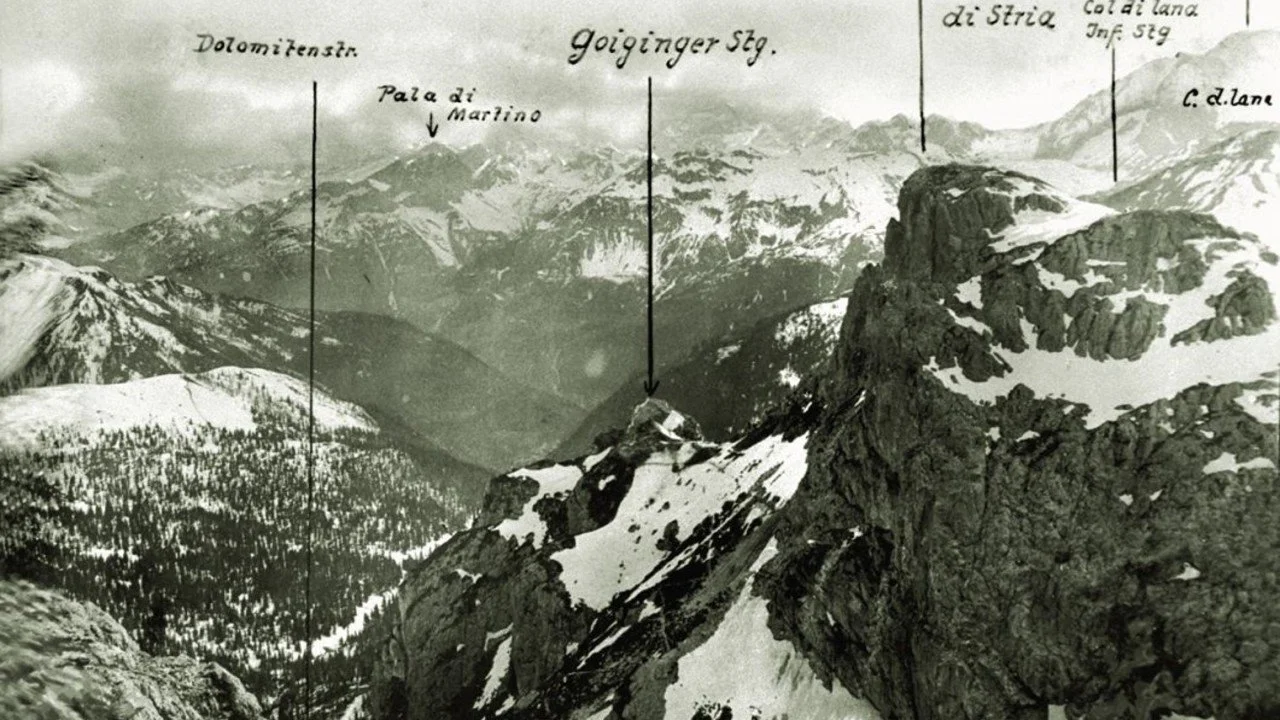
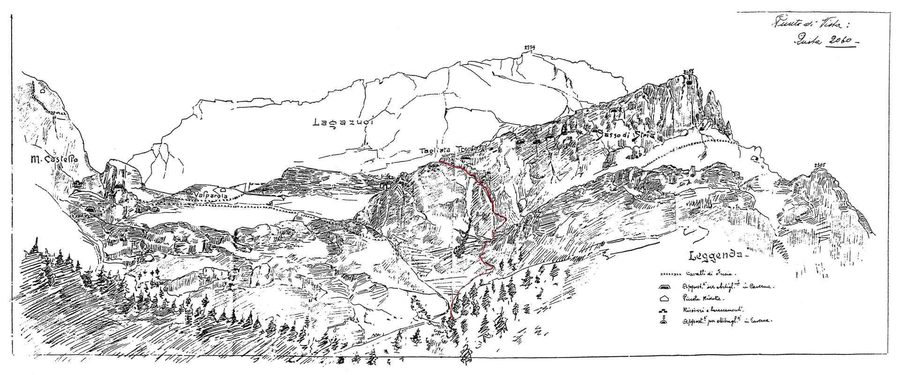
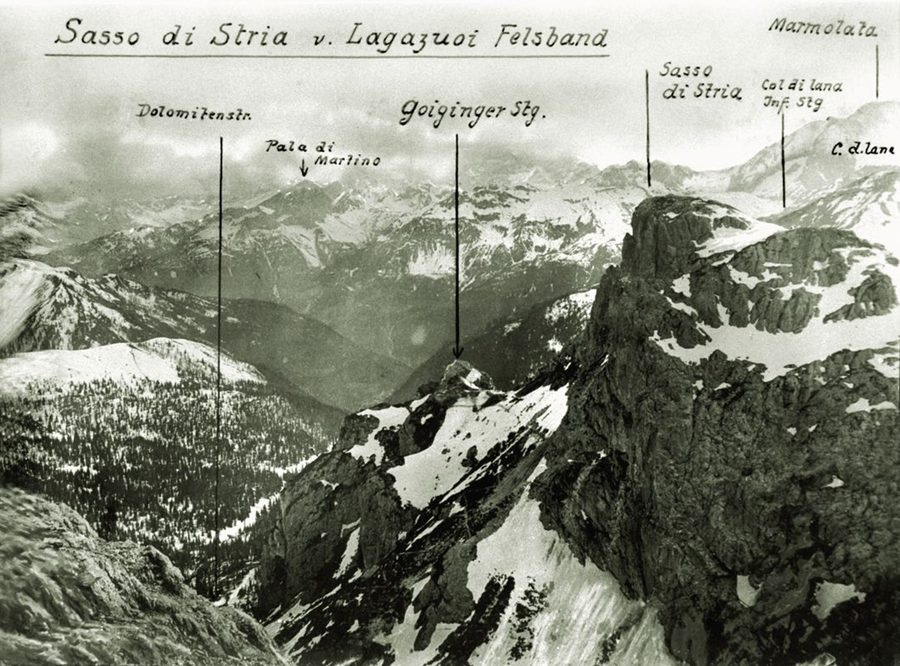
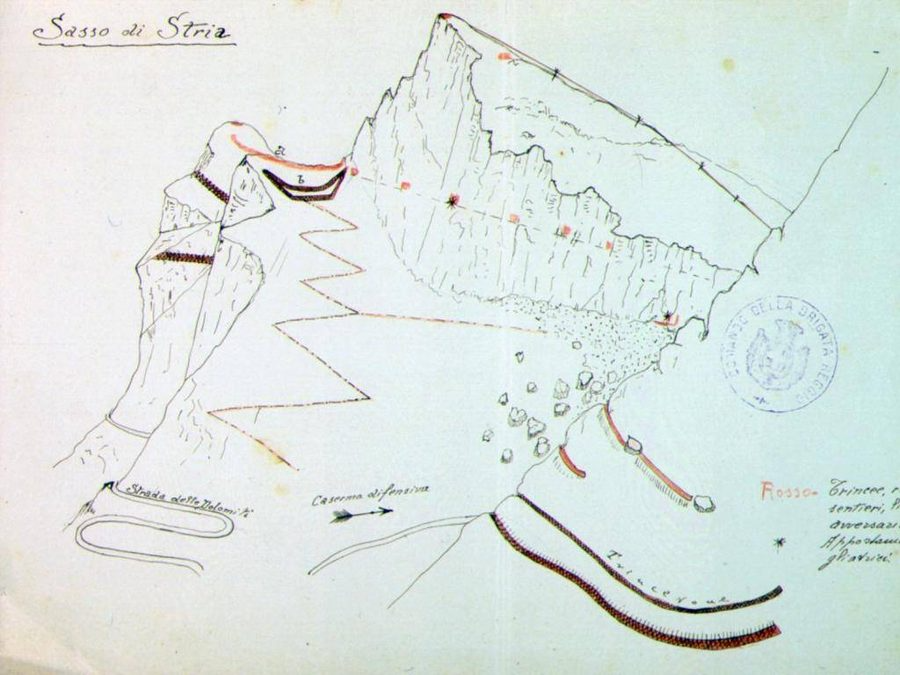
Both sides drew maps obsessively. The Italian tactical sketch below was produced early in the campaign, when officers were still establishing which ground they could hold. The mountains on it are the same mountains visible from the trail today: Lagazuoi, M. Castello, Valparola. The red lines are Italian positions; the dotted lines, enemy tunnels. The Austrians produced their own documents with equal precision: a photographic survey taken from the Lagazuoi ledge labels every opposing peak — Sasso di Stria, Col di Lana, Marmolata — the names of places where men were dying.
A Name on a List
Among the documents that survive from the earliest fighting here is a typed roster headed Componenti la pattuglia del 17-18 Ottobre 1915 (Sasso di Stria) — Members of the patrol of 17-18 October 1915. Sixteen names. Against each: MORTO. FERITO. ILLESO. Killed. Wounded. Unharmed.
The first name is Sottotenente Fusetti Mario — 2nd Lieutenant Mario Fusetti, the patrol commander. His designation: MORTO. He was twenty-four. The after-action report describes how 15 volunteers were called for un’ardua azione — a difficult action — to climb Sasso di Stria by night, surprise the Austrian sentries, and hold the position until reinforcements arrived. The moon was still bright. They waited, lying on the scree, for the moment to move.
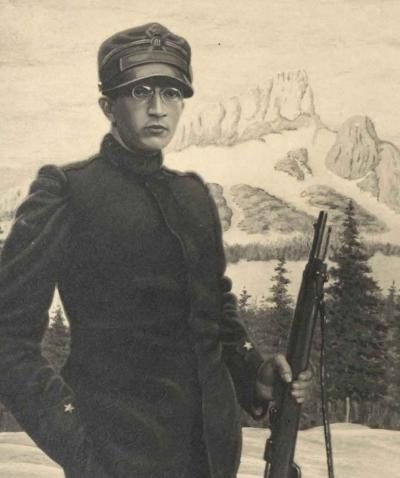
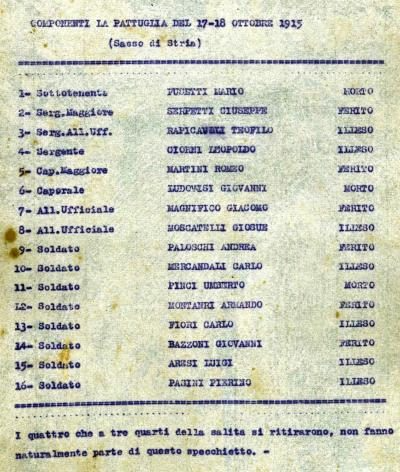
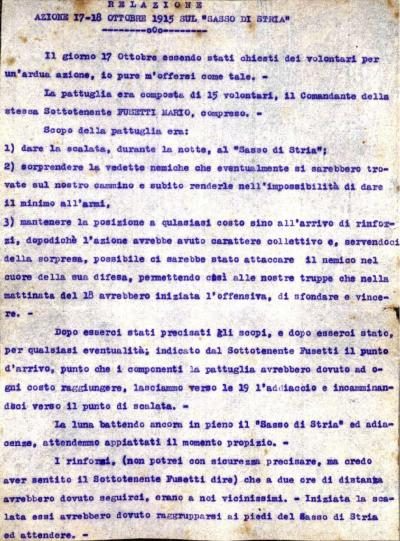
The patrol of 17-18 October 1915 was one of the first Italian attempts to take Sasso di Stria, the rocky peak immediately adjacent to Lagazuoi. The mountain remained contested throughout the war. Fusetti’s death on the first night of serious fighting established the pattern: these heights were extraordinarily difficult to take and impossible to hold without the tunnel systems that both sides were already beginning to dig.
Entering the Mountain
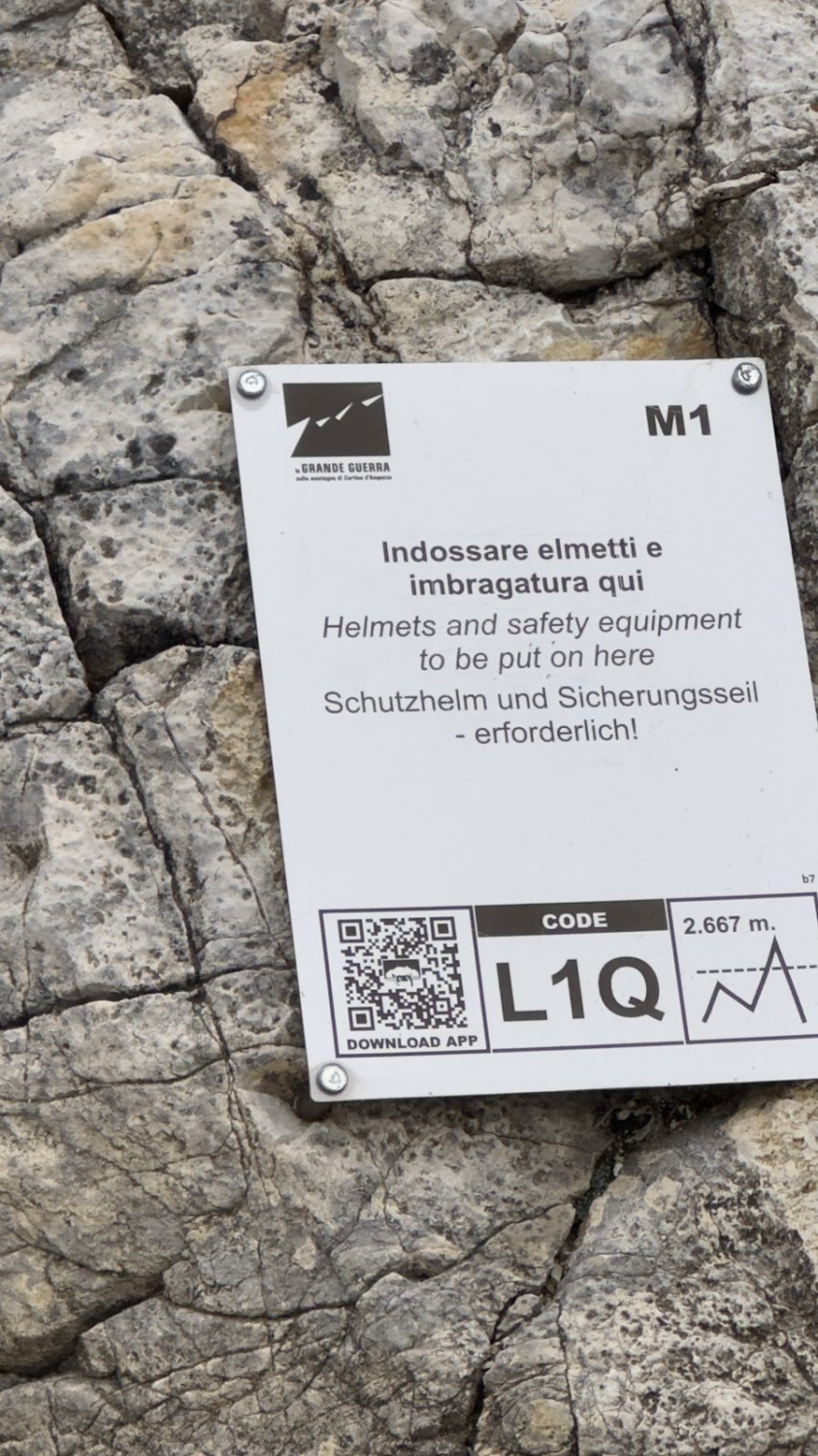
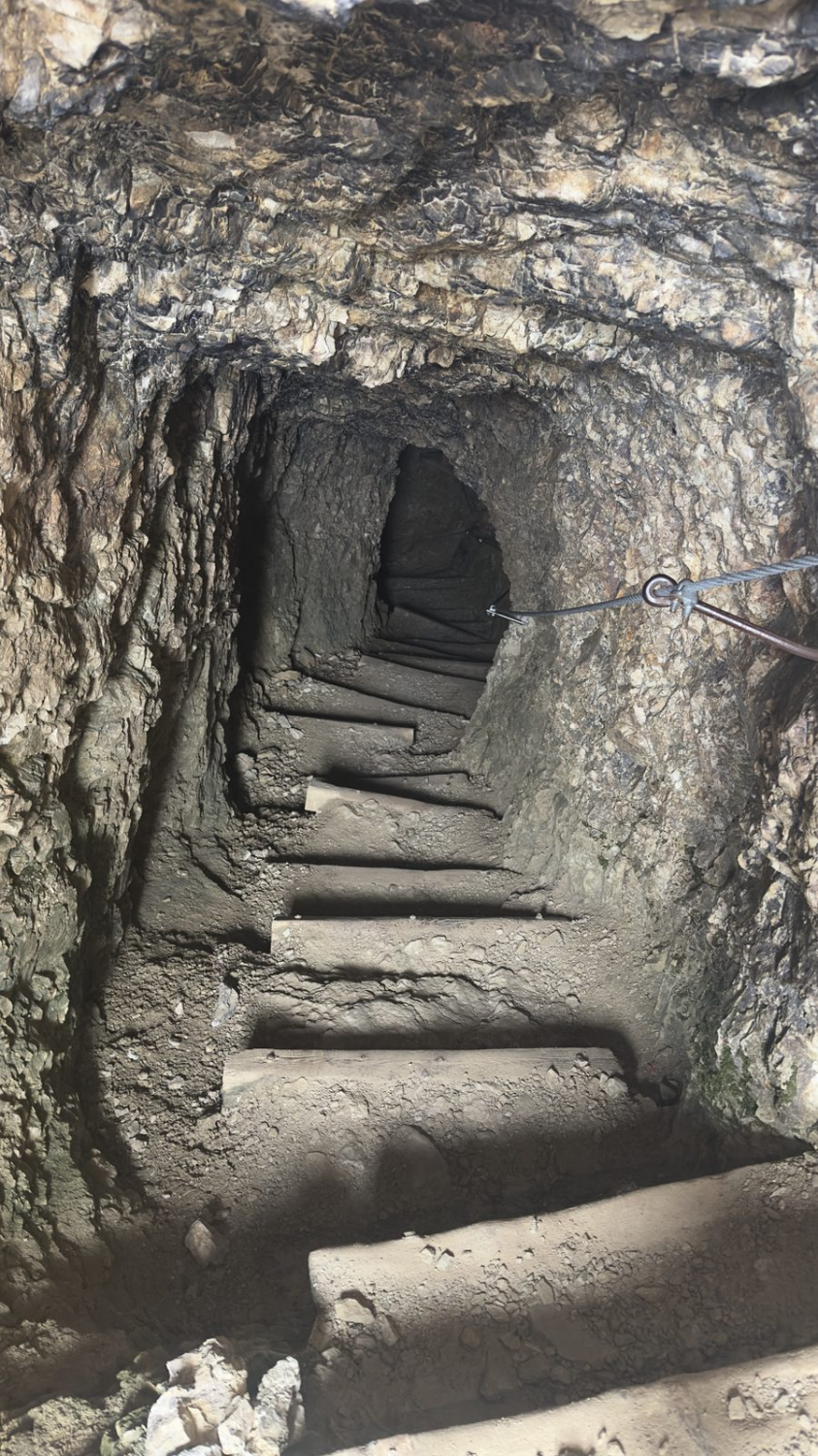
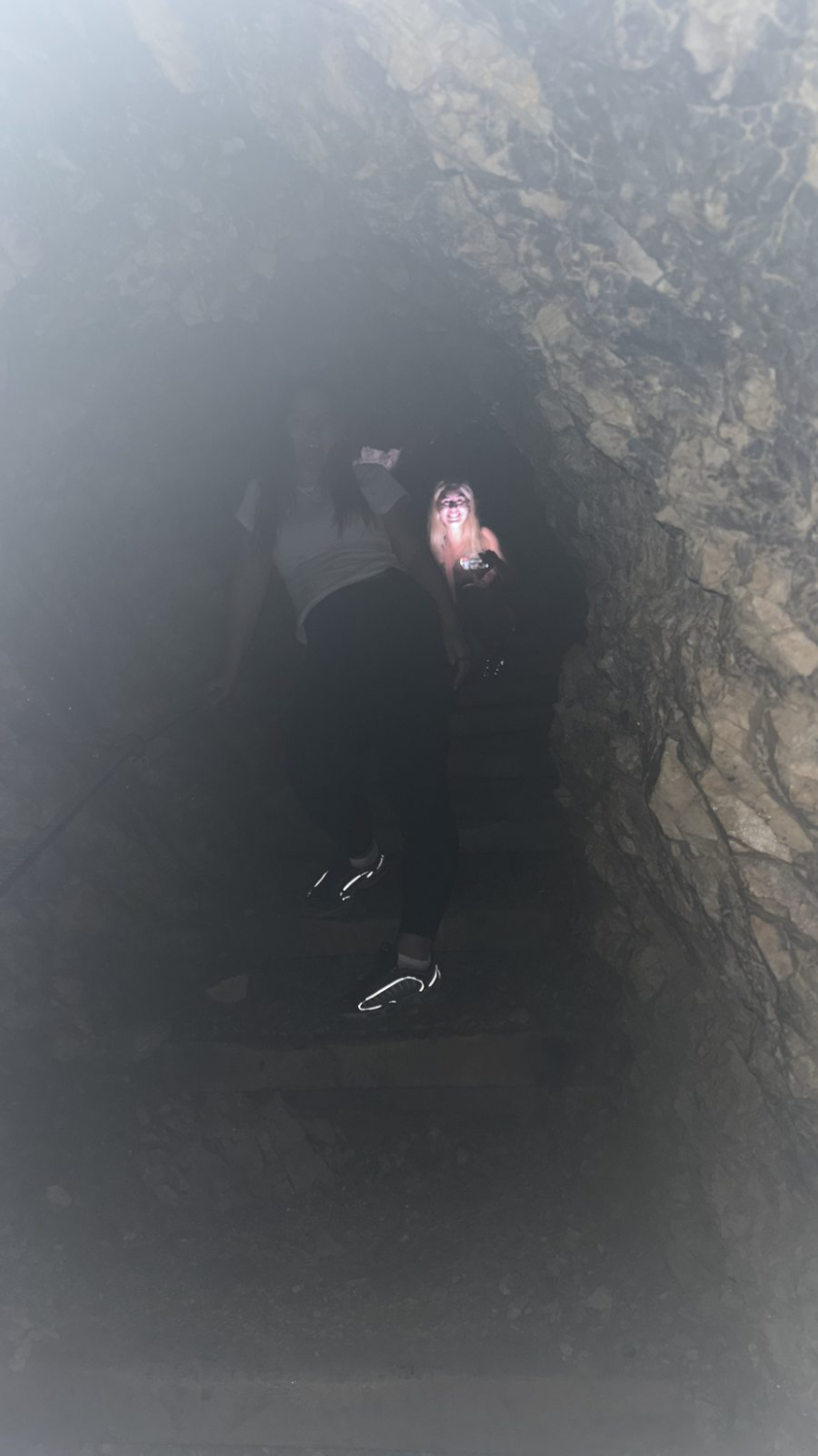
The trail climbs steeply from Passo Falzarego before the first sign demands a pause: Elmetto e attrezzatura di sicurezza obbligatoria — helmets and safety equipment required (code L1Q, 2,667 m). The rock opens into darkness. You step from Dolomite sunlight into a tunnel barely wide enough for two people abreast. The temperature drops. The walls are wet.
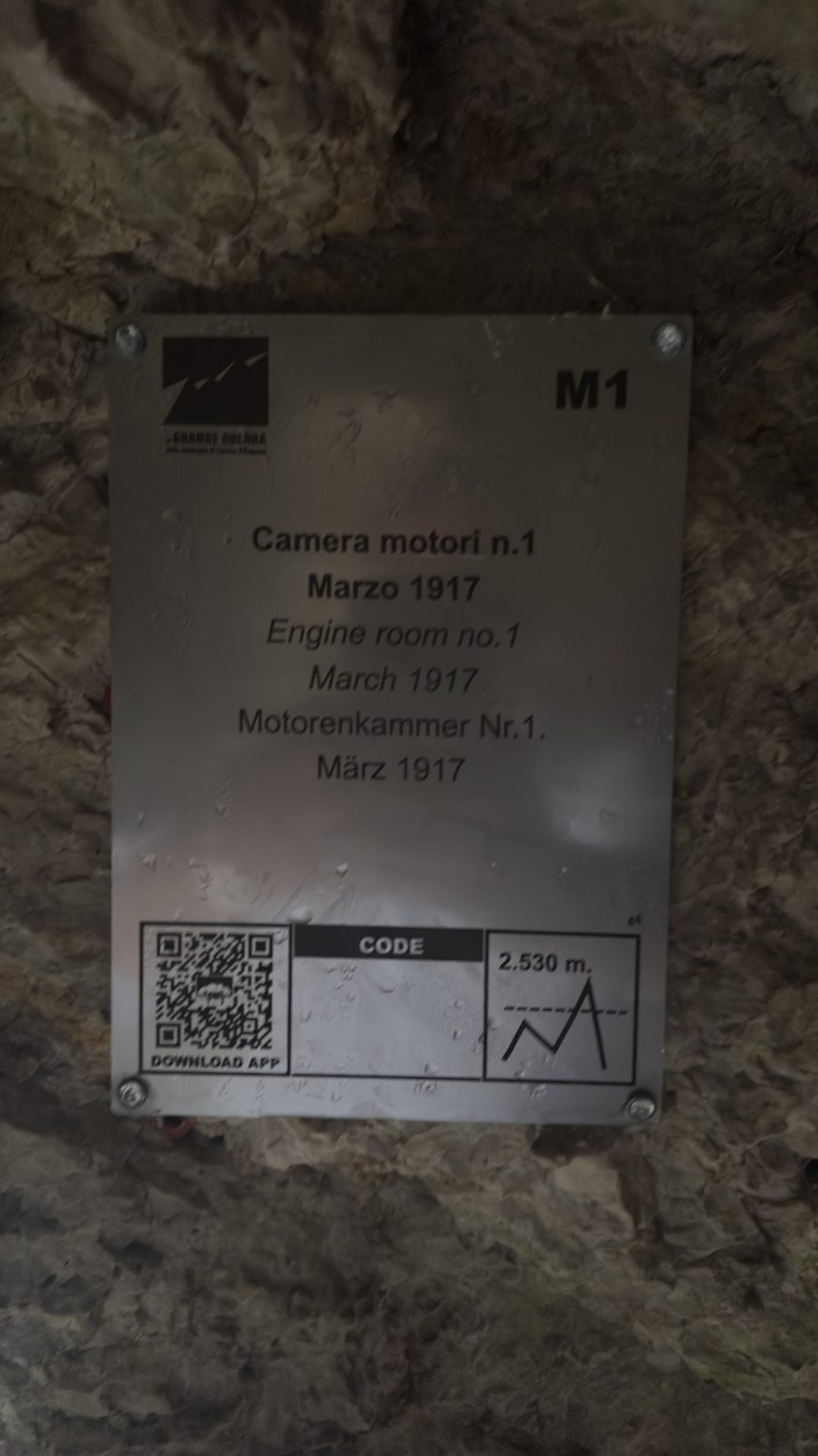
The Italian army assigned the tunnel work largely to former quarrymen from the Alps — men trained since childhood in drilling and blasting rock. They worked in shifts, in passages no wider than a doorframe, using hand-operated drilling machines and chisels. By March 1917 the effort had advanced far enough to justify a permanent infrastructure: Camera motori n.1 — Engine Room No. 1 — carved into the rock at 2,530 m to provide electric power for the drills working higher into the mountain.
The Guns Inside the Rock
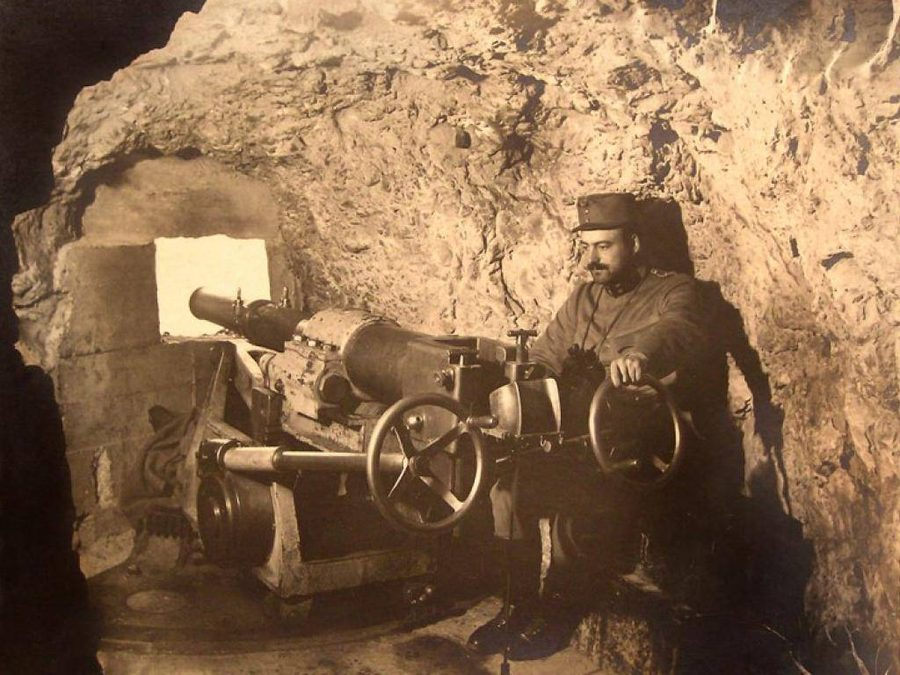
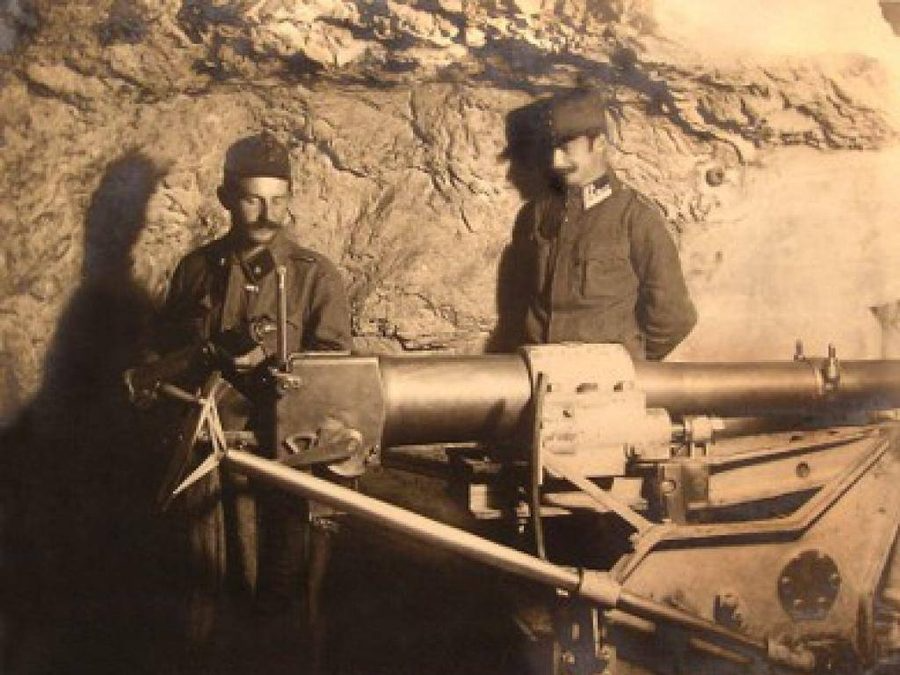
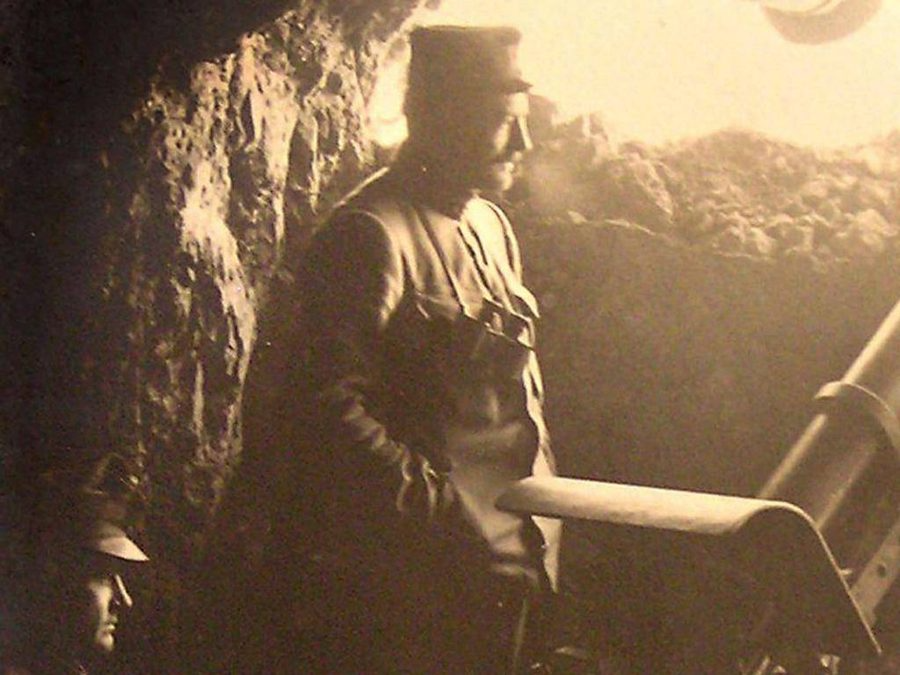
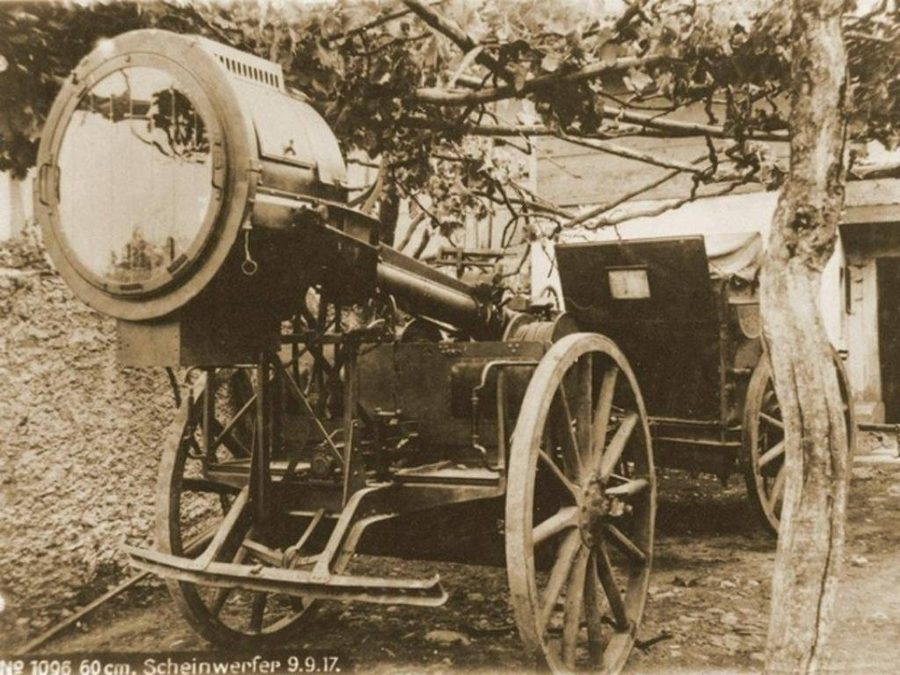
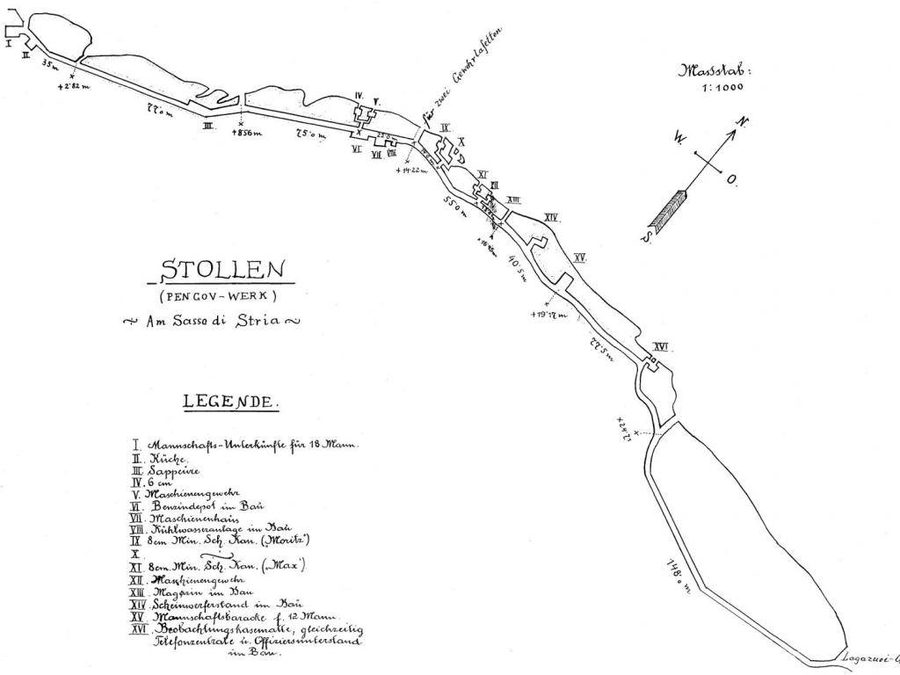
The tunnels were not only for movement and mining. Both sides cut weapon embrasures into the cliff faces — slits through which cannon and machine guns could cover the passes below while remaining almost invisible from outside. The Austrian tunnel plan for Sasso di Stria, drawn at 1:1000 scale, shows exactly how these systems worked: barracks, kitchen, fuel depot, machine gun posts, two named cannon positions (“Max” and “Moritz”), a searchlight stand, and an observation-telephone bunker — all connected by a single gallery running 118 metres from the lower entrance to the summit command post.
The Counter-Mine War
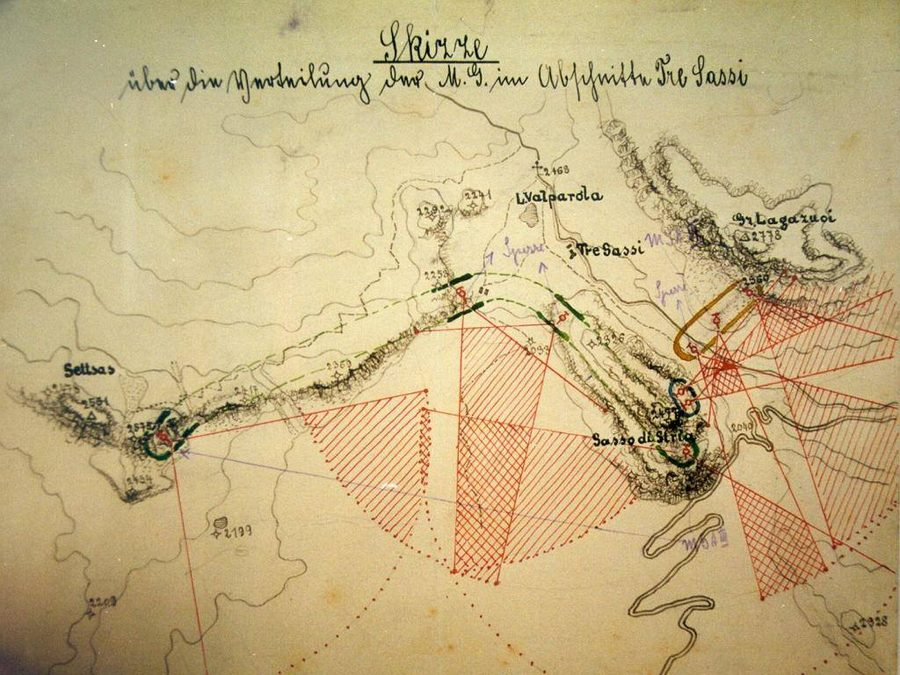
The Austrian MG positions map — titled Skizze über die Aufstellung der MG im Abschnitt Tre Sassi — shows overlapping fields of fire in red hatching radiating from each position. Gr. Lagazuoi 2778 m is marked in the upper right. No part of the valley floor was safe. Against this, the Italians dug.
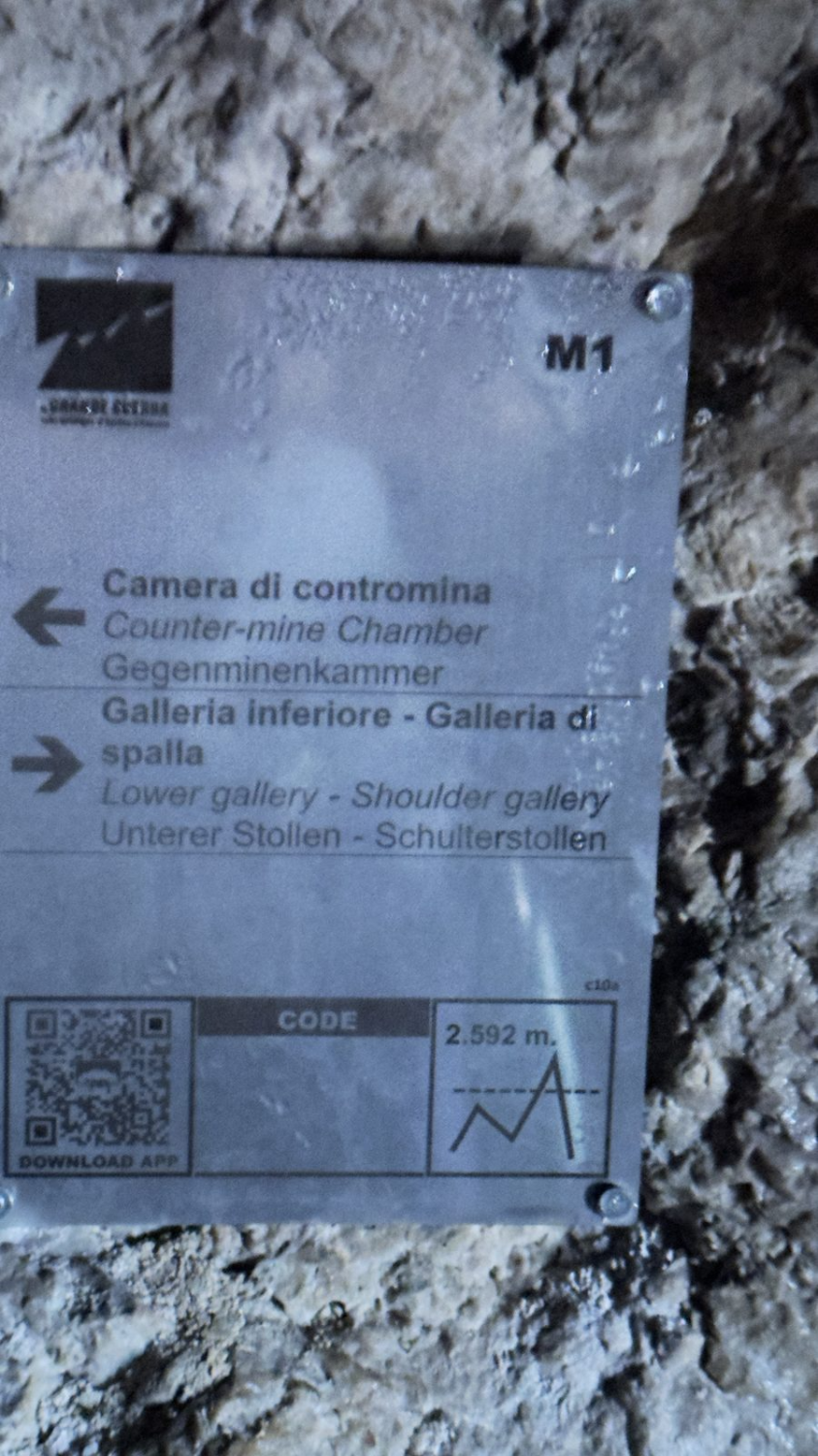
A junction sign inside the tunnel — Camera di contromina / Lower gallery / Shoulder gallery — marks where the Italians bored a parallel gallery specifically to detect Austrian counter-mining above them. At times the two sides were separated by only a few metres of stone. Miners on both sides could hear each other working. The errori di scavo signs mark places where the Italian tunnellers lost their bearing in the dark and drilled the wrong direction for days before realising the mistake.
20 June 1917: The Mine
Everything in the tunnel complex was in preparation for one moment. On 20 June 1917, after months of drilling, digging errors, and four Austrian counter-mines — the last fired just four weeks earlier on 22 May with 30,400 kg of explosive — the Italians detonated 33,000 kilograms of blasting gelatin packed into a chamber at 2,620 m. The explosion was heard across the valley.
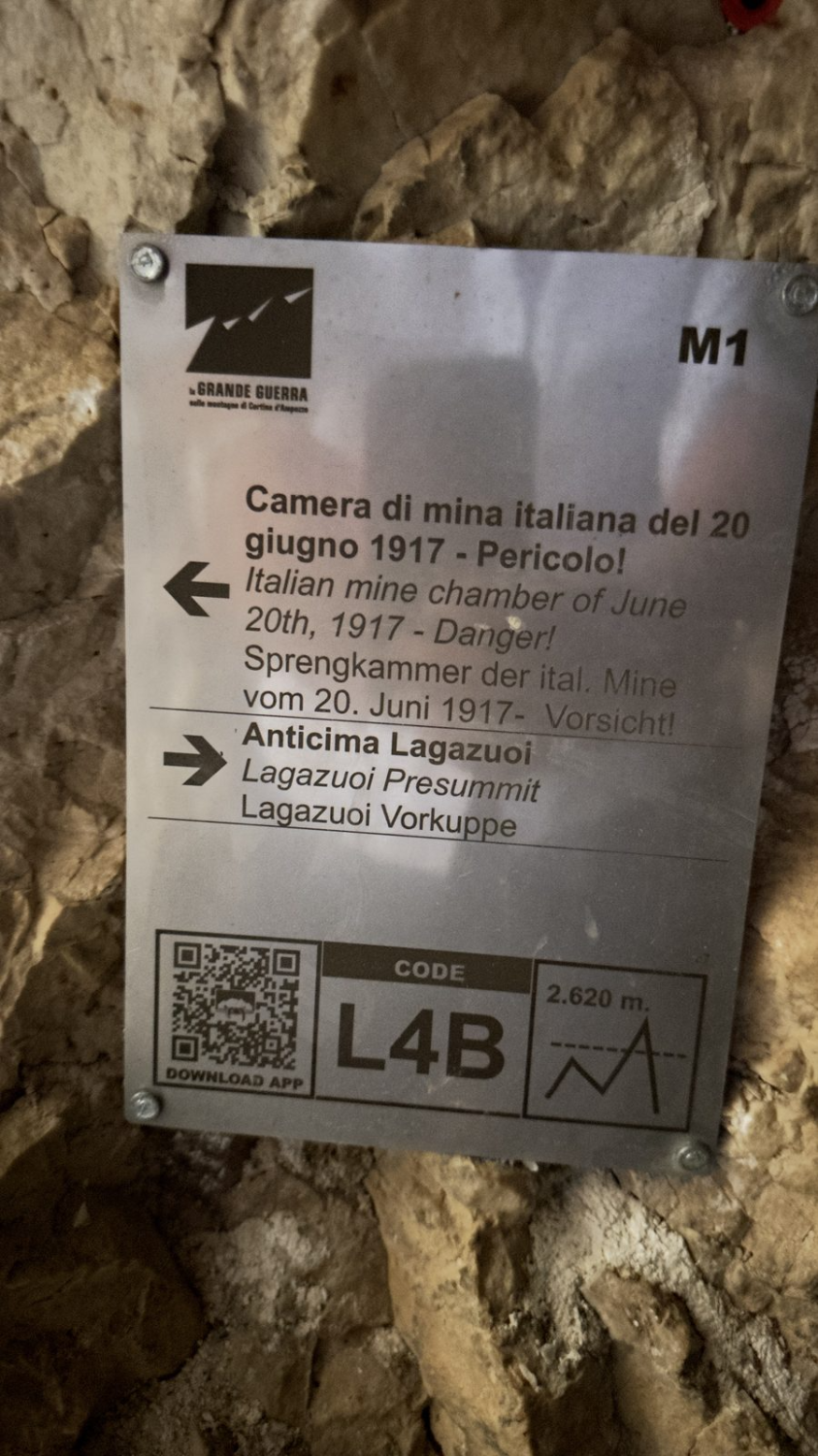
The sign at the chamber (code L4B) reads: Camera di mina italiana del 20 giugno 1917 — Pericolo! Even now the structure is considered unsafe. Higher up at 2,685 m the trail marker reads: Bordo cratere mina italiana del 20 giugno 1917 — edge of the crater. Standing at the lip, the explosion ceases to be a statistic. The Austrian forces had been partly warned by their own counter-mining and had evacuated some positions. The war on Lagazuoi continued until October 1917.
Between January 1916 and September 1917, five mines were detonated on Lagazuoi — three Austrian (300 kg, 16,000 kg, 30,400 kg) and two Italian, including the main charge of 33,000 kg on 20 June 1917. Across the entire Italian alpine front, 34 mines were fired between 1916 and 1918. The hard Dolomite rock made this work far more difficult than equivalent operations on the Western Front’s chalk and clay.
Living Inside the Rock
The tunnel is nearly a kilometre long and overcomes 400 metres of altitude. For stretches of the war, men lived in it almost continuously. A widened chamber on the descent preserves a reconstruction of a soldier’s quarters: wooden bunks, a mess table, a helmet, a grenade. The ceiling is black with soot. Outside in winter, temperatures reached −30°C. On White Friday, 13 December 1916, avalanches triggered by artillery killed an estimated 10,000 soldiers across the Dolomite front in a single day. Inside the mountain, men survived.
Light at the End
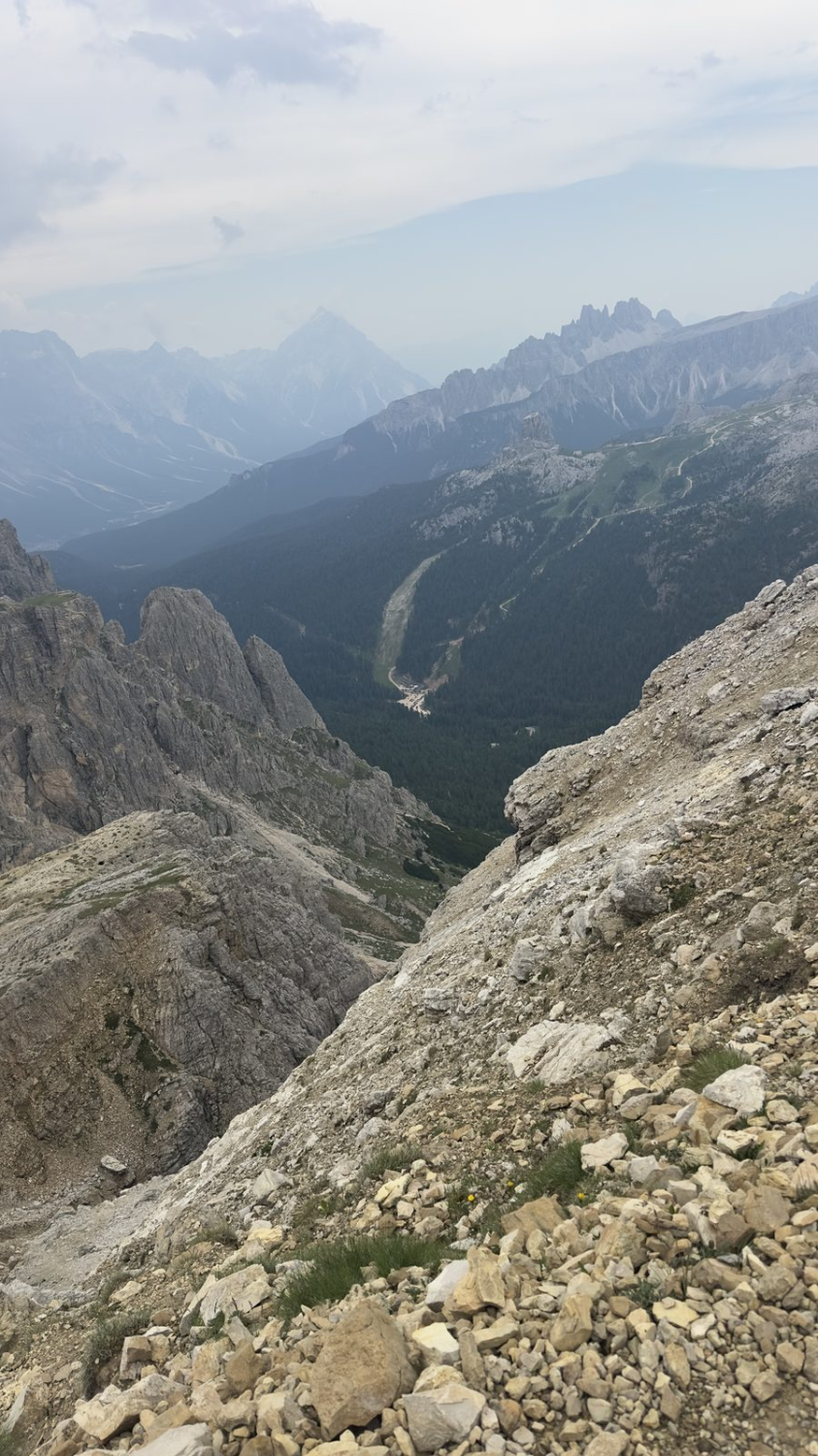
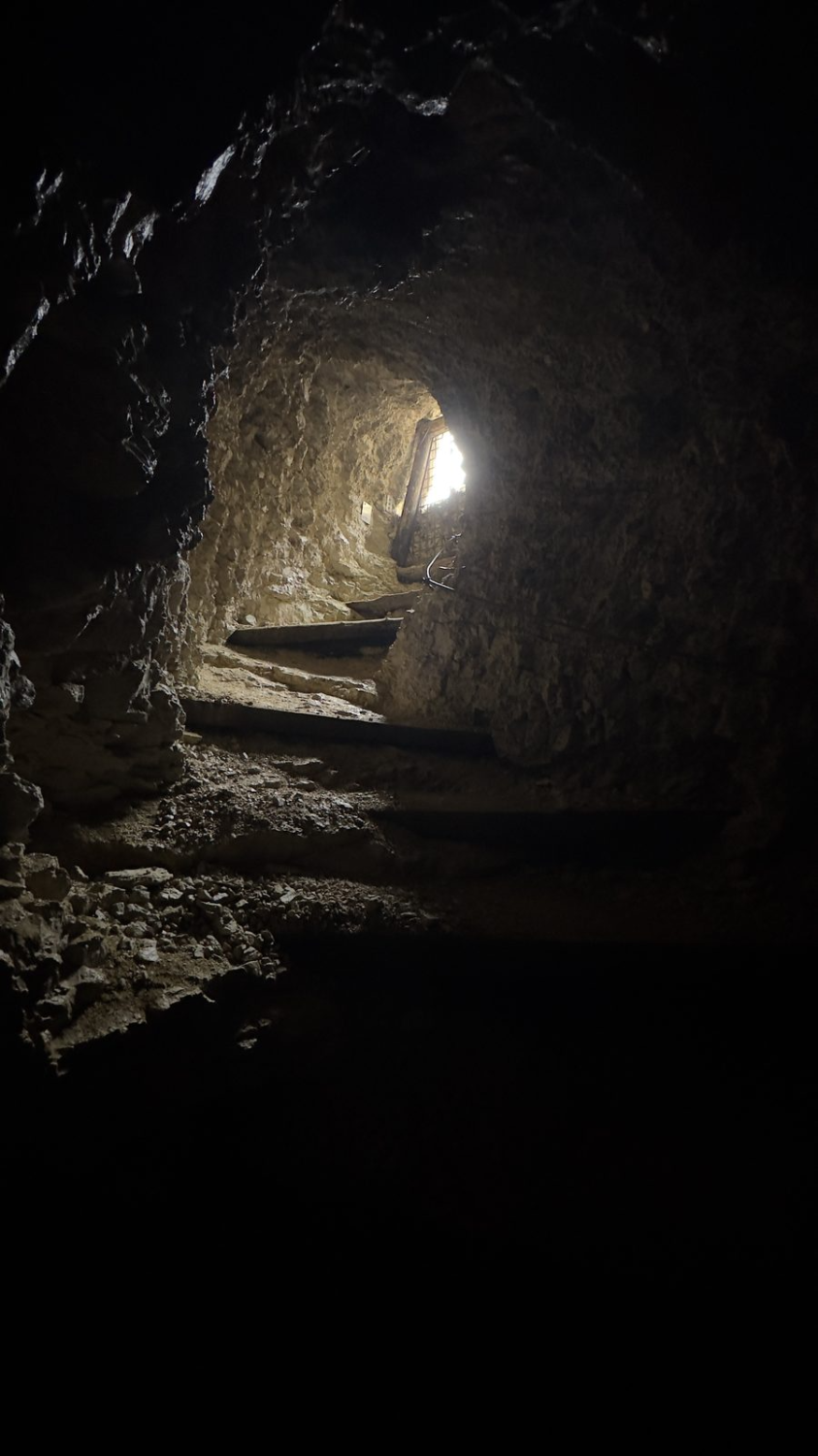
At intervals the gallery breaks open onto the cliff face. A steel wire keeps you from the edge. Beyond it the valley drops 500 metres. These openings were observation ports and, when necessary, gun embrasures — cannon aimed at the road and the passes below. Today they frame one of the most remarkable views in the Alps.
The tunnels eventually give way to the open ridge near the summit at 2,778 m. The QR codes on the trail markers link to an audio guide and archival photographs, adding voices to the silence. But you do not need them. The primary sources are all around you: the fractured limestone of the mine crater, the engine room bolted into rock at 2,530 m, the patrol roster where a name is followed by a single word.
Mario Fusetti was twenty-four and died on the first serious night of fighting in this sector in October 1915. The mountain was still contested two years later when the mine went off. It took a further year and the catastrophe at Caporetto — where 250,000 Italian soldiers were taken prisoner — before the front collapsed. More than 650,000 Italians died in the First World War. The Dolomites are beautiful. Inside them, the evidence of what that beauty cost is carved into the stone.
Monte Lagazuoi (2,778 m) · La Grande Guerra Heritage Trail M1 · Passo Falzarego, Cortina d’Ampezzo, Dolomites, Italy Sources: Wikipedia — Mines on the Italian Front (WWI) · lagazuoi.it · R. Striffler, Der Minenkrieg in den Dolomiten (1993) · Primary documents: Archivio storico, Museo della Grande Guerra, Cortina d’Ampezzo